

What Meta Took
Two audiences erased for posting public federal records. The third account was disabled within a day. There is no appeal, no human review, and no recourse.

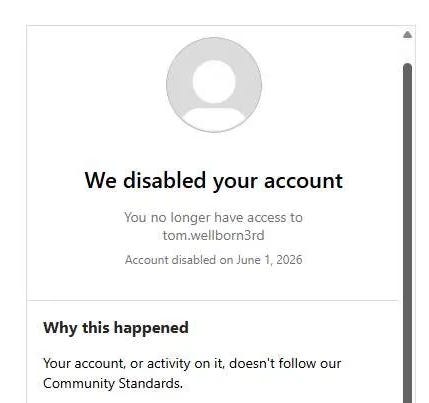
This piece is being written in response to a notification I received on June 1, 2026, which arrived in the form of a small text box informing me that I no longer have access to my account on Threads, that my account had been disabled, and that the reason given was a generic statement that my activity does not follow Meta’s Community Standards. No specific Community Standard was identified. No specific post was identified. No specific date of violation was identified. The screen contains a button labeled, with the polite uselessness that distinguishes Meta’s customer interfaces, “Appeal.”
The appeal does not go anywhere a human being will read it. I know this because I have used the appeal button before, twice, in good faith, in full detail, with attached screenshots and clarifying explanations, on each of the two prior occasions when Meta disabled an audience I had spent years building on its platform. The first time, in 2024, the account suspended had approximately twenty-two thousand followers, the result of fourteen months of consistent posting, reciprocal engagement, and the building of what Meta’s own marketing material describes as “real friendships with real people.” The second time, in 2025, the account suspended had approximately thirty thousand followers, the result of additional months of starting again from zero on a second account and rebuilding the connections that Meta had previously erased. The appeal I filed on the first suspension was never answered. The appeal I filed on the second suspension was never answered. I waited seven months between the second suspension and the creation of a third account, in the hope that the cooling interval would satisfy whatever automated trigger had taken the prior two accounts down.
The third account, opened in May 2026, was challenged to verify by phone number and photograph within a day of its creation. I provided both. The account was placed into what Meta calls “appeal” status before I had finished setting up the profile. It was suspended shortly afterward. The notification arrived on June 1. The screenshot is at the top of this piece. I have not, on the documentary record, posted anything on the third account other than the verification materials Meta itself requested.
The content I was posting across the prior two accounts, on the days each was suspended and in the weeks leading up to those suspensions, is documented in my own records and was, on each occasion, the redistribution of publicly available material from the Department of Justice’s Epstein-file disclosures. The material in question is not contested, not classified, not subject to court seal, and not the subject of any active legal action against me or anyone else who has redistributed it. It is federal records. It is in the public domain. It has been published by news organizations, civil society groups, and individual citizens across every major platform.
The relevant comparison, which is the cold analytical fact at the center of this case, is that the same material I have posted on Threads, on the dates I was suspended, was cross-posted by me to Bluesky and to X, the latter being a platform I actively dislike and would prefer not to use. I have never received a single warning from either Bluesky or X. I have never received a single content notice from either. I have never had an account disabled on either. The variable in this comparison is not the content. The content has been demonstrated to circulate without incident on two competing platforms. The variable is the platform itself. Meta has made a choice. The choice has a direction. The direction is observable in the documentary record of which accounts have been disabled and which have not.
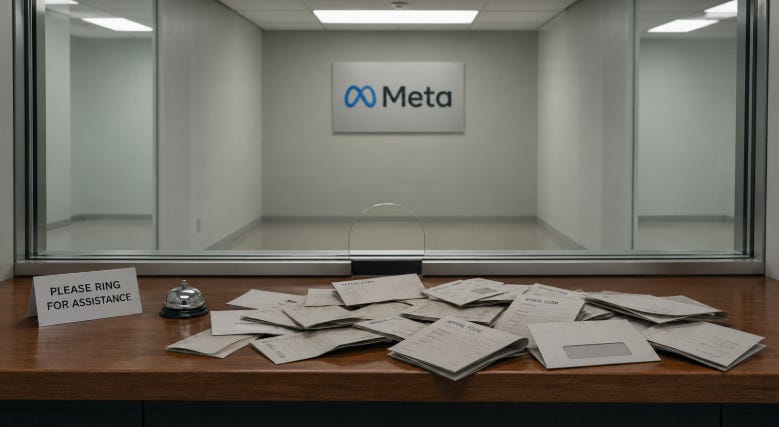
The architecture of Meta’s enforcement system is, by design, unappealable. The “Community Standards” cited as the basis for each of my three suspensions are written at a level of generality that does not permit a meaningful response. No specific provision is named. No specific post is named. No specific date is named. The user is invited to acknowledge violation in the abstract or to appeal in the abstract, and either acknowledgment or appeal is routed to the same automated review apparatus that issued the suspension. There is no human in the loop. There has, across three suspensions and three years on the platform, been no human in any loop at any point. The official appeal mechanism, which I have used three times, has produced zero substantive responses, zero specific findings, and zero acknowledgments that a human being read what I wrote.
Meta has, across the period during which my three suspensions occurred, employed three different individuals in the leadership positions notionally responsible for Threads. Mark Zuckerberg has been the Chief Executive Officer of Meta Platforms throughout the period in question and is the individual to whom every operational decision at the company ultimately reports. Adam Mosseri, the head of Instagram, oversaw Threads from its July 2023 launch through mid-September 2025 and continues to provide strategic oversight of the platform from his position one level up. Connor Hayes, a longtime Meta executive formerly the Vice President of Product for Generative AI, became the dedicated head of Threads in September 2025 and continues to report to Mosseri. Each of these individuals presides over a customer service architecture that, in my documented experience as a three-time suspended user, produces no responses, no specific findings, and no human contact under any circumstance.
The structural observation that follows from this evidence is the larger point of this piece, and it is the point I would ask any reader who has built any kind of presence on a Meta product to consider seriously, regardless of whether they share my politics or my interests.
The product Meta sells is not, despite the marketing language, a service. The product Meta sells is the user. The user is the inventory. The platforms Meta operates, Facebook, Instagram, Threads, and the related properties, function by acquiring users at scale, encouraging those users to invest substantial personal capital in building social relationships, professional networks, audiences, and creative output on the platform, and then monetizing the resulting engagement to advertisers. This is the basic business model and is publicly disclosed in Meta’s annual reports. The corollary, which is less publicly emphasized, is that the user’s relationships, networks, audiences, and creative output exist at Meta’s operational discretion. The user does not own the audience. The user did not, on enrolling, sign a meaningful service agreement that compels Meta to maintain the audience or to provide notice before terminating access to it. The user has, in fact, signed away the right to challenge the company’s termination decisions in any forum other than Meta’s own internal appeal mechanism, which is, as a documented operational matter, not staffed in any way that produces substantive responses.
The result is a system in which a private corporation, headquartered in Menlo Park, California, with approximately three billion users globally and revenues last year in excess of one hundred and sixty billion dollars, operates the largest information utility in the history of human communication with the customer service architecture of a parking enforcement bureau. There is no number to call. There is no email to write. There is no human being who can be reached. The promise the platform sells, the building of real friendships with real people, is real to the user, who experiences the relationships as real because they are. The relationships are not real to the platform. The relationships are the product. The product can be destroyed when the company finds it convenient.
I have, on the documented record, twice built an audience on Meta’s text platform that ran into the tens of thousands of followers, twice had that audience erased by the platform with no specific reason given and no human response to multiple good-faith appeals, and now had a third attempt to begin again disabled within twenty-four hours of account verification. The cumulative effect is the loss of three years of work, the severance of approximately fifty-two thousand follower relationships, the disappearance of the engagement history that constitutes the documentary record of my participation in the platform’s community, and the practical certainty that any future account I attempt to create on Meta will be subjected to the same treatment. I have been blacklisted in fact, if not in stated policy, for posting public federal records that two competing platforms have hosted without comment.
The defense Meta will offer, if it offers one, which on the available evidence it will not, is that the enforcement system is automated, that errors occur at scale, and that the appeal mechanism exists for users to contest those errors. The defense is contradicted by the documentary record of my three accounts. Three suspensions, three appeals filed in good faith with full documentation, zero responses, zero specific findings, zero reinstatements. The system Meta describes as the corrective mechanism for automated errors is, in operational practice, the same automated system that issued the original suspension, configured to ignore the user’s response. It is appeal in form and silence in substance.
The second defense, which Meta has historically offered in similar cases, is that the company is a private actor and is therefore free to host or refuse to host any content it chooses. This defense is legally correct under current American law and is morally and structurally irrelevant. The question is not whether Meta has the legal right to disable my account. The question is whether a private corporation operating an information utility at this scale, with no functional appeal mechanism, with no accountability to users whose audiences it erases, with no transparency obligation regarding the criteria of its enforcement, and with a documented pattern of suspending accounts that redistribute material from one specific category of federal records, ought to be regarded, by users and by regulators, as the kind of institution to which serious personal and civic investment should continue to be entrusted. The answer is increasingly clear, and the answer does not depend on any user’s politics. The answer depends on the architecture of the system itself.
The wider implication for any reader who has built any kind of presence on a Meta platform is the structural one. The audience you have built feels like your audience because you built it. The audience is not your audience in any meaningful operational sense. The audience is Meta’s audience. Meta is renting it to you, on terms it can revoke at any moment, for any reason or for no stated reason, with no recourse other than an appeal mechanism that has been engineered to produce no response. The relationships are real to you. They are inventory to the platform. The day the platform finds them inconvenient, or the day an automated classifier determines that your activity has crossed an undisclosed threshold, the relationships will be terminated, the followers will be unable to find you, the years of accumulated personal capital will be erased, and the company will offer you no specific explanation, no specific finding, and no specific path to recover what you have lost.
This has now happened to me three times. It will, statistically, on the basis of the company’s documented enforcement patterns, happen to substantial numbers of other users across the next several years. The users to whom it happens will, like me, file appeals. The appeals will not be answered. The users will write essays. The essays will not be read by anyone who reports to Zuckerberg, Mosseri, or Hayes. The cycle will continue because the system has been designed to continue.
The cold analytical conclusion is the only one available from the evidence. Meta is not a community. Meta is not a friend. Meta is not a service provider in the meaningful sense of provider, because what is provided can be withdrawn without notice, without cause, and without recourse. Meta is a private corporation that has built a magnificent and profitable business on the rental of human relationships back to the humans who formed them, and the rental terms are entirely on Meta’s side. Anyone who continues to invest personal capital in Meta platforms is doing so with the available understanding that the investment can be erased at any moment, by an automated system that cannot be appealed, on the basis of criteria that will not be specified, by a corporation that will not respond.
The audience felt like mine. The audience was never mine. The audience was Meta’s.
I am already rebuilding it elsewhere.
cc Facebook Newsroom Facebook Support
Please check out my new book for about the same price as a cup of Starbucks coffee and learn about one of life’s most significant journeys: https://www.amazon.com/dp/B0H37KYQT3
Similar story to @theaisurvivalclub https://theaisurvivalclub.substack.com/p/meta-bans-ai-ethicist-with-580k-followers who had many more followers...
the pattern suggests in "following the money" the algorithm is preventing content creators, once they become compensatable, by simple deleting accounts. while zuckerbergs yachts continue to loom over the future
Fool me once, shame on you. Fool me twice, shame on me.
Fool me thrice? "Can't fool me again." - GWB
Anyway, you gave Suckerberg far more than he ever deserved.
Welcome to Substack, I look forward to your posts.