
The Zone Has Coordinates
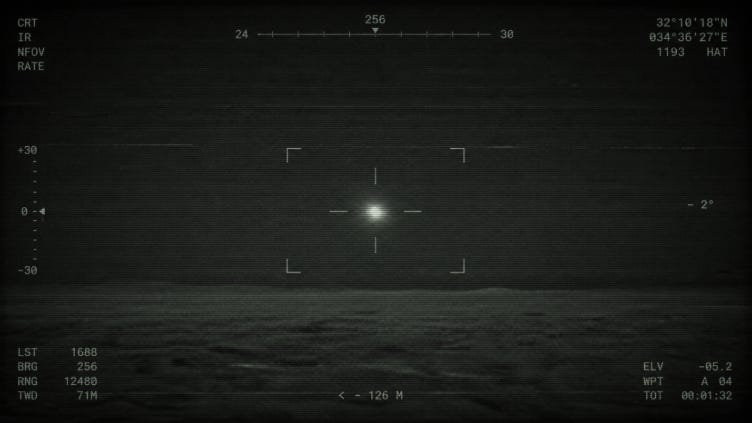
Forty seconds of thermal footage from the May 22 files, read the way you read a scene: frame by frame, refusing to look away.

There is a file in the second PURSUE release that does not belong in a press dump. It is catalogued as DOW-UAP-PR051, titled in the flat institutional monotone of the archive as Syrian UAP instant acceleration, and it sits on a Department of War web page between weather balloons and procedural noise like a single coherent sentence dropped into static. The portal around it has logged more than a billion visits, which is to say it has been consumed the way everything is consumed now. Scrolled, clipped, captioned, argued over for an afternoon, and abandoned by morning. Strip away the billion clicks and the provenance squabble and the partisan theater that attends every government gesture in this exhausted year, and what actually remains is roughly forty seconds of thermal video.
I want to read those forty seconds the way I read a scene. Slowly, without forcing them, frame by frame, because that is the only honest way to watch something that may not want to be understood. The disclosure conversation has been poisoned for decades by two species of impatience that present themselves as opposites and are secretly the same animal. The believer who needs the object to be a craft from somewhere else, and the debunker who needs it to be a Mylar balloon catching the wind, are both in a hurry to stop looking. Both lunge for the meaning before the watching is finished. I am proposing the contrary discipline, the one a Russian filmmaker spent his entire life defending, and I am proposing to apply it to a piece of footage shot by a machine that was built to kill.
Sculpting in time
Andrei Tarkovsky distrusted the cut. He regarded montage, the rapid assembly of fragments that Sergei Eisenstein had elevated into the native grammar of cinema, as a kind of well-mannered lie, a way of deciding on the viewer’s behalf what mattered before the viewer had any chance to feel it for themselves. In his book on filmmaking, he insisted that the true material of the medium was not the image but time itself, and he described the director’s labor as sculpting in time, carving sense out of raw duration the way a sculptor carves a figure out of resistant marble. So his camera held. It held past comfort and past convention, past the precise moment when any sensible editor would have moved the audience gently along, until the duration stopped functioning as a container for events and quietly became the event. You stop waiting for something to occur. You begin, gradually, almost against your will, to see what was standing in front of you the whole time.
Stalker, his austere 1979 adaptation of a Strugatsky brothers novel, is the purest distillation of that faith. Some unnamed visitation has left behind a region called the Zone, sealed off and ringed by soldiers, where the ordinary laws of space and motion no longer reliably hold. You cannot cross it in a straight line. The guide, the Stalker of the title, leads his two paying clients by throwing metal nuts wrapped in strips of cloth ahead of them, reading a path that rearranges itself and refuses to be mapped. At the dead center of the Zone waits a Room rumored to grant the visitor his most secret and authentic wish. The Writer goes seeking inspiration he has lost. The Professor goes, we eventually learn, carrying a bomb. The film moves at the pace of dread and patience, the mundane outer world rendered in exhausted sepia and the Zone breaking open into damp green color, and Tarkovsky dares you to look away from puddles and wet concrete and the back of a man’s head until the looking itself becomes a moral act.
Keep reading with a 7-day free trial
Subscribe to PolitiMix to keep reading this post and get 7 days of free access to the full post archives.