

The UAP Pattern They Keep Not Explaining
Both ends of a 67-year pattern over American nuclear sites, in one release. And still, only grainy footage.

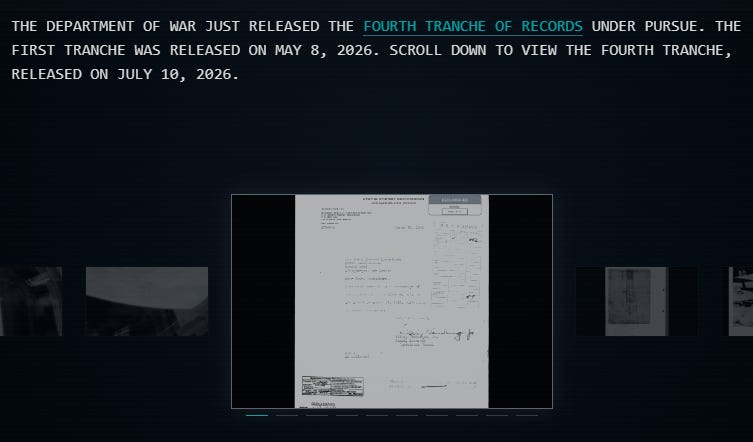
The United States government released its fourth batch of UAP files today.
Forty items. Fourteen documents, nineteen videos, four audio files, three images, drawn from the Pentagon, NASA, the CIA, the FBI, and the Department of Energy. It is the latest installment in the disclosure process initiated under the current administration’s declassification order, and the Pentagon has stated it will not be the last.
I have gone through what has been reported from the tranche, and I want to be clear about two things before I get to the substance. The first is that there is something in this release that genuinely matters, a pattern that runs unbroken across sixty-seven years and lands, in this single drop, with both of its endpoints documented in government files. The second is that the way this material continues to be released raises a question that grows harder to ignore with each tranche, which is whether the people releasing it are actually serious about disclosure at all.
Let me take the substance first.
The Nuclear Thread
On September 1, 2015, an unidentified object entered the airspace over Pantex.
If you do not know what Pantex is, that is by design, and it is worth correcting. Pantex, located near Amarillo, Texas, is the primary assembly and disassembly facility for the United States nuclear weapons stockpile. It is where American nuclear warheads are built, maintained, and taken apart. It is one of the most secured pieces of ground in the Western Hemisphere. It is not a place where things drift into the airspace and nobody notices.
Something drifted into the airspace. The facility was placed on lockdown. Two security officers pursued the object by vehicle, and according to the Energy Department report, they were unable to catch up to it, even though witnesses described it as moving at only ten to fifteen miles per hour. They stopped their vehicle. They got out. They observed the object through binoculars. And they reported three things that, taken together, do not resolve into any conventional explanation.
The object made no sound.
They could identify no propulsion system.
And after one to two minutes, it continued north and left the site.
The witnesses described a diamond-shaped object, rounded at the top, roughly four feet tall and two feet wide at the base. They disagreed about its color. Some said black. Others said silver, red, and blue. This disagreement is the kind of detail that skeptics correctly flag as a marker of unreliable observation, and it deserves to be noted honestly. But the disagreement about color sits alongside agreement about the things that matter more: the silence, the absence of visible propulsion, the fact that a four-foot object moving at fifteen miles per hour could not be overtaken by trained security personnel in a vehicle at the nation’s primary nuclear weapons facility.
Hold that image. Now go back sixty-seven years.
Los Alamos, 1949
The same tranche released today contains the transcript of a conference held in 1949 at Los Alamos, New Mexico. The subject of the conference was a series of sightings of what came to be called green fireballs, anomalous luminous objects that had been appearing over the American Southwest, and specifically over its nuclear installations, since 1948.
The attendees were not cranks. They were among the most accomplished physical scientists in the world, including veterans of the Manhattan Project, the men who had built the atomic bomb three years earlier and a short drive away. The conference was convened because the green fireballs were appearing over Los Alamos, over Sandia, over the installations where the American nuclear program lived, and the government wanted to know what they were.
The featured testimony came from Dr. Lincoln LaPaz, a meteoriticist, a man whose entire professional life was the study of objects that fall from the sky. LaPaz told the conference he had personally seen one of the green fireballs, and that it was, in his professional judgment, “most certainly not a conventional meteorite fall.” He described a fireball that appeared “in full intensity instantly,” which meteors do not do, that broke into “bright green” fragments, that traveled on a nearly horizontal path, which meteors do not do, and that maintained continuous brightness, which meteors do not do. He said he could not find any example of a conventional meteorite behaving this way anywhere in the entire literature of his field.
And then LaPaz said the thing that connects directly, across sixty-seven years, to the two security officers standing in the Texas dark with their binoculars.
He said the most implausible feature of all was the lack of sound.
The 1949 conference concluded without an explanation. The Army at the time reportedly suspected the objects might be some form of radiological warfare experiment conducted by a foreign power, which is to say the government’s own working theory was that someone was doing something with radiation over the birthplace of the atomic bomb. No such program was ever identified. The green fireballs were never explained. The file was, eventually, closed the way these files are always closed, which is to say not with an answer but with the exhaustion of official attention.
One Drop. Both Bookends.
Here is what makes today’s release worth writing about, when so many of these drops are not.
The government released, in a single tranche, both ends of the same thread. The 1948 to 1949 origin, when unexplained silent objects first began appearing over the facilities where America built its nuclear arsenal, examined by the very scientists who built it. And the 2015 continuation, when a silent, propulsionless object entered the airspace over the facility where America still assembles that arsenal, and could not be caught, and left on its own schedule.
Sixty-seven years. Same phenomenon. Same nuclear nexus. Same three features: silence, no identifiable propulsion, flight characteristics that trained observers could not reconcile with anything they knew. Manhattan Project physicists could not explain it in 1949. Energy Department security officers could not explain it in 2015. Nobody in between has explained it either.
The UAP-nuclear connection is not new to anyone who has followed this subject seriously. Robert Hastings spent decades documenting incidents of unidentified objects over ICBM silos and weapons storage facilities, including the well-known 1967 Malmstrom incident in which multiple Minuteman missiles reportedly went offline while an object was observed overhead. Former officers have testified to Congress about it. What today’s release does is place two of the strongest documented bookends of that pattern into the official record simultaneously, sourced from the government’s own files, with the government’s own inability to explain them attached.
Whatever these objects are, they have been interested in our nuclear weapons for as long as we have had them. That is not a fringe claim. That is what the documents say.
The Other Items, Briefly
The nuclear thread is the story, but the tranche contains three other items worth flagging.
There is a 2023 case over the Yellow Sea in which a UAP appears to have progressively degraded the electro-optical and infrared sensor footage of a U.S. military platform over nearly five minutes, the footage deteriorating throughout the encounter. If that holds up under scrutiny, it moves the conversation from “what are these things” to “what can these things do,” which is a different and more serious category of question.
There is a 2020 Atlantic encounter whose video appears to match the long-rumored “floating brain” object, a blob-shaped form with narrower appendages beneath it, footage that researchers have referenced for years and that is now confirmed to be real and in government possession.
And there is a 2019 range-fouler report from a military aviator with twenty-eight years of combined Air Force and Navy service, who described an object with flight characteristics “unlike anything I had seen,” a small object that was tracked traveling at high speed before it outpaced the sensor’s ability to follow it entirely. Twenty-eight years in military aviation is a great deal of sky. When a person with that much time behind them says they saw something they could not categorize, the correct response is not a smirk.
Now the Problem
Here is where my enthusiasm meets my suspicion, and I am not going to pretend the second one isn’t there.
Every image in this release is grainy. Every video is the same low-resolution infrared smear we have been handed in every prior tranche. We are once again looking at blobs and contrast patches and heat signatures, at footage that is just clear enough to be provocative and just unclear enough to be deniable.
And we know, because whistleblowers under oath have told us, because military and intelligence personnel have testified to Congress, that high-resolution UAP material exists. There is imagery of dramatically higher quality held within the government’s classified holdings. The people who have seen it have said so, publicly, at personal and professional risk. It is not a secret that the good footage exists. It is only a secret what the good footage shows.
So what are we to make of a disclosure process that, four tranches deep, has delivered exactly none of it?
There are charitable explanations. High-resolution footage reveals sensor capabilities, and the government protects the specifications of its sensors more jealously than it protects almost anything, because those specifications are how it sees adversaries who do not know they are being seen. Releasing pristine UAP footage might reveal exactly how good American infrared and radar systems actually are, which is genuine and legitimate national security territory.
But the charitable explanation only goes so far, because it has an obvious remedy, which is to release the footage with the sensor metadata stripped or degraded, showing the object clearly while obscuring the instrument. The technology to do this is not exotic. If the will existed to show us what these things actually look like while protecting the how of the seeing, it could be done.
It is not being done.
What we are getting instead is a rolling release of material chosen, apparently, precisely because it is ambiguous enough to satisfy the letter of a disclosure order without ever risking the substance of actual disclosure. We get the documents, which are extraordinary, because documents describe without showing. And we get the video, which is uniformly poor, because poor video can be released without the government ever having to stand behind what a clear image would force it to confront.
This is the shape of a disclosure process designed to look like transparency while functioning as its opposite. It hands the public enough to keep the subject alive and never enough to force a reckoning. It is the bureaucratic equivalent of the object over Pantex: it moves slowly, in plain sight, at a speed that should make it easy to catch, and somehow you can never quite close the distance.
I am glad the files are coming out. The nuclear thread alone justifies every hour anyone has spent pushing for this. LaPaz’s testimony and the Pantex report belong in the public record, and today they are.
But four tranches in, I am no longer willing to treat this as good-faith disclosure until the resolution improves. The government is showing us the documents that describe the phenomenon and withholding the images that would prove it. It knows the difference. So do we.
The pattern over our nuclear facilities has run unbroken for sixty-seven years, and the government still cannot explain it.
The pattern in how they release the evidence is only four tranches old, and I think I can.