

The Redaction Is the Confession
You don't spend this much institutional energy protecting a man from the Epstein documents that allegedly exonerate him.

Start with what we know, because what we know is enough to make the question unavoidable, and the question is why the government is working this hard to prevent you from asking it.
In October 2002, Donald Trump told New York Magazine that Jeffrey Epstein was “a terrific guy” and that they had known each other for fifteen years. “He’s a lot of fun to be with,” Trump said. “It is even said that he likes beautiful women as much as I do, and many of them are on the younger side.” He said this in his own voice, in print, with his name attached, about a man who would later be federally indicted for sex trafficking minors. The quote has never been disputed or retracted. It is the most honest thing Trump has ever said about his relationship with Epstein, and he said it before anyone was watching closely enough to make him regret it.
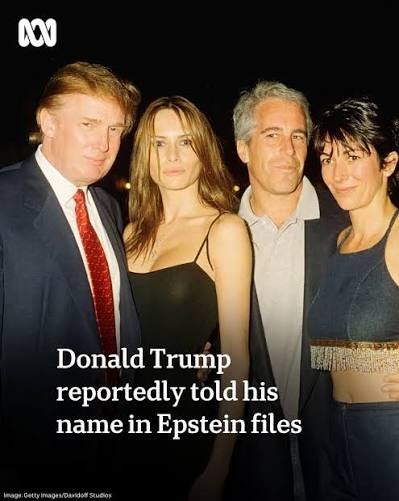
They lived 1.4 miles apart in Palm Beach. Trump purchased Mar-a-Lago in 1985. Epstein purchased his nearby estate in 1990. They developed what the documentary record describes as a social friendship of roughly fifteen years, which tracks with the timeline Trump himself provided in 2002. In 1992, Trump hosted a private party at Mar-a-Lago with more than two dozen women flown in to provide entertainment. The only other guest was Jeffrey Epstein. Flight logs released by the Department of Justice show Trump took at least eight flights on Epstein’s private jet between 1993 and 1997. Epstein attended Trump’s 1993 wedding to Marla Maples. They were photographed together at a Victoria’s Secret party in 1997 and at Mar-a-Lago in 2000.
This is the documented baseline. It is not disputed. It is in the flight logs, in the photographs, in Trump’s own words to a national magazine.
Now the women.
Virginia Giuffre, one of Epstein’s most prominent accusers, was employed at Mar-a-Lago as a locker-room attendant in 2000, confirmed by Social Security records submitted in her defamation case against Maxwell. She alleges that Maxwell recruited her there and brought her to Epstein’s home, where she became what she has described as a teen sex slave beginning at age seventeen. Maxwell was convicted of sex trafficking in 2021. Giuffre’s account of her recruitment from Trump’s club has never been disproven.
A witness identified in court only as “Jane” testified during Maxwell’s 2021 trial that Epstein introduced her to Trump at Mar-a-Lago in the 1990s when she was fourteen years old. She also acknowledged competing in the Miss Teen USA pageant in 1998, a pageant Trump owned from 1996 to 2015. She did not describe any inappropriate behavior by Trump during that meeting. Four other contestants in the 1997 Miss Teen USA pageant told BuzzFeed that Trump walked through their changing rooms while they were undressing. Three additional contestants confirmed the account but did not want their names used. The incidents are documented, reported, and have not been retracted.
Stacey Williams, a former Sports Illustrated swimsuit model, alleged that Trump groped her in front of Epstein during a visit to Trump Tower. Trump denied it.
A lawsuit filed in 2016 and subsequently dropped alleged that Trump repeatedly raped a thirteen-year-old girl at Epstein’s New York apartment in 1994. The plaintiff, identified as Jane Doe, withdrew the case before it was adjudicated. The allegations were never proven in court.
E. Jean Carroll was proven in court. A federal jury in 2023 found that Trump had sexually abused her, a finding that met the legal definition of rape under New York law though the jury did not apply that specific label. The jury also found Trump liable for defamation for statements he made denying her account after leaving office. He was ordered to pay $83.3 million in a subsequent defamation trial. He has called the verdict a hoax and a political attack and has not expressed remorse of any kind.
Sixteen women have accused Trump of various forms of sexual misconduct, ranging from groping to rape, across a period from the early 1980s through 2013. He has denied all of them. He has been found liable for sexual abuse by a jury. He has thirty-four felony convictions for falsifying business records. He is the president of the United States.
Now the files.
The Epstein Files Transparency Act, which Trump signed into law, required the full release of all unclassified DOJ Epstein records by December 19, 2025. The DOJ missed the deadline. What was released was heavily redacted, with some pages entirely blacked out. Sixteen files were pulled from the DOJ website within hours of posting, including one that contained a photograph of Trump. The DOJ said the files were being removed to protect victims. Critics noted that a photograph of the president is not a victim’s identity.
Over a dozen Epstein survivors described the initial release as riddled with abnormal and extreme redactions with no explanation. Chuck Schumer called the redaction pattern a violation of the law Congress had passed. The DOJ issued a statement pre-labeling some of the Trump-related documents as “untrue and sensationalist claims made against President Trump that were submitted to the FBI right before the 2020 election,” which is a remarkable posture for a law enforcement agency to take toward its own files before the public has read them. The DOJ’s job is to release the documents. Characterizing their contents in advance of public review is something else.
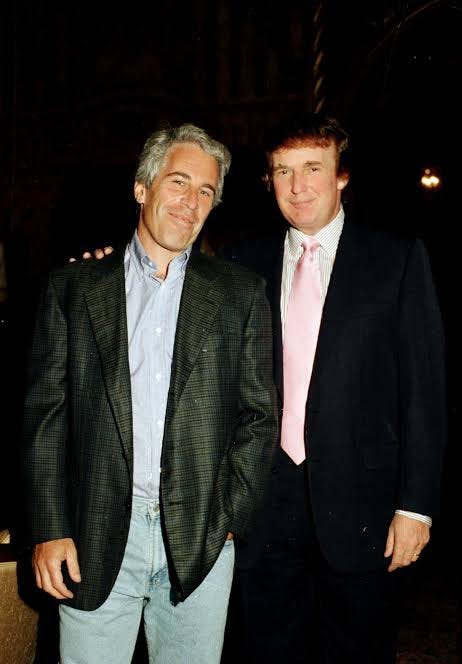
Subsequent tranches added more references to Trump, including an email referencing a photograph of Trump and Ghislaine Maxwell found on Steve Bannon’s phone during a federal investigation. The November 2025 release of 20,000 records from Epstein’s estate showed that Epstein’s messages “often referenced Mr. Trump.” The administration has promised three million total pages. As of this writing, the releases remain partial, the redactions remain dense, and no schedule for completing the process has been made public.
Todd Blanche, Trump’s former personal defense attorney and current Acting Attorney General, personally conducted a two-day interview with Ghislaine Maxwell in prison in 2025. Maxwell was subsequently transferred to a minimum-security facility. Blanche has stated publicly that the DOJ did not protect Trump in its handling of the files. The Situation Room meetings documented in the Haberman and Swan reporting on Regime Change show the administration’s senior staff, including the vice president, convening in the most secure space in the federal government specifically to manage the political fallout of the president’s Epstein exposure, in rooms chosen because they feared their own colleagues would leak.
You do not convene the Situation Room to manage the fallout from documents that clear you. You do not have your former personal defense attorney interview the convicted accomplice. You do not pull files from your own website hours after posting them. You do not pre-label your own documents as untrue before the public reads them. You do not redact your own files at the scale and density that researchers who have downloaded and indexed the full available dataset describe, with the president’s name appearing in ways the redaction architecture appears specifically designed to obscure.
None of what I have written above proves that Trump committed crimes in connection with Epstein’s operation. The documented record does not establish that and I am not claiming it does. What the documented record establishes is a fifteen-year social friendship between two men who shared documented tastes, a pattern of proximity to Epstein’s victims including a teenager brought to his club and a recruitment that occurred on his property, a paper trail the president has spent enormous institutional energy managing, and a government that is applying the full weight of its classified infrastructure to control what the public is permitted to read about the relationship.
That is not the behavior of innocence. Innocent men do not convene the Situation Room. Innocent men do not have their attorneys interview the accomplice. Innocent men do not pull their own documents from their own websites. Innocent men do not pre-characterize their own files.
The redaction is not a legal finding. It is not a verdict. It is a choice, made by people with access to the complete record, about what you are allowed to see. And the shape of that choice, the density of it, the institutional machinery deployed to maintain it, the personal involvement of the man at the center of it in every decision about its scope, tells you something that the unredacted text might or might not confirm.
Governments do not protect men from documents that exonerate them. They protect men from documents that don’t.
The files are still coming. The redactions are still dense. The Situation Room is still the room they chose. And the man who called Epstein a terrific guy who liked them on the younger side is still the man deciding what you get to read about it.
That is the confession. It is not in the files. It is in the black bars across them.