
The Grief With No Face
A companion to How to Last, for the people who have moved past political dread and into something heavier: the slow, faceless fear of what is happening to the world itself.

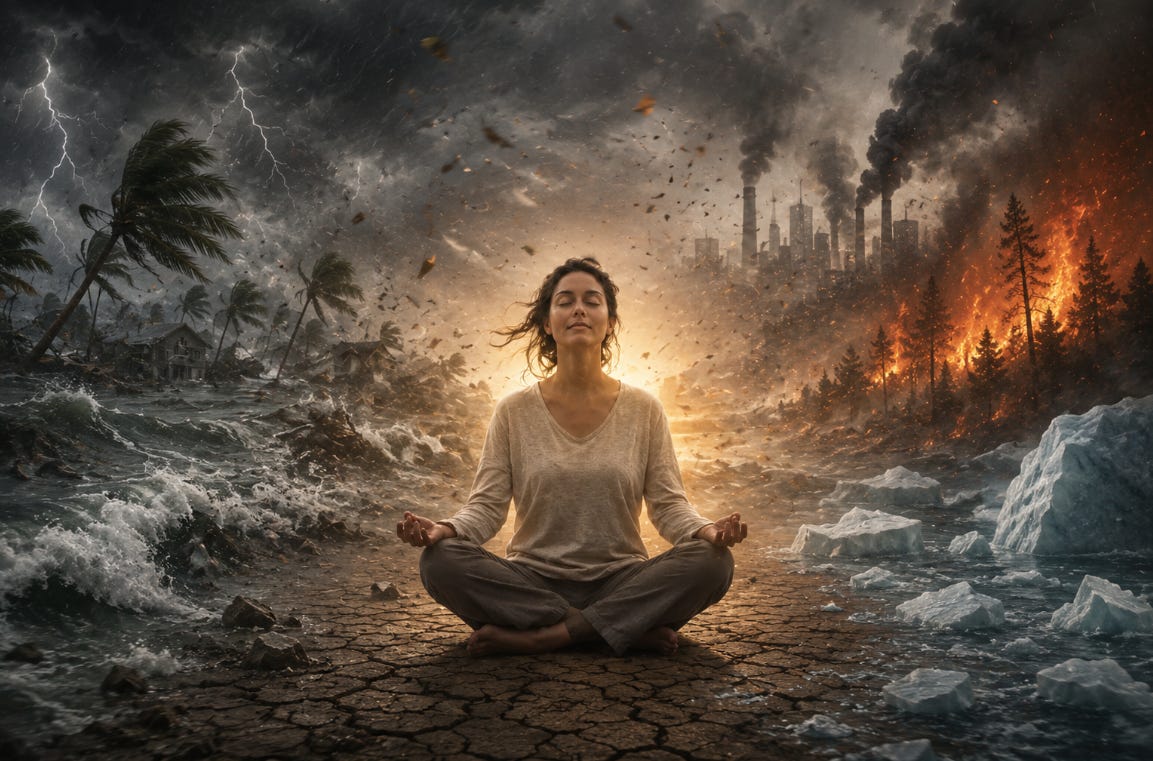
A reader wrote to me after the last piece to say that it helped, and that she believed it, and that it no longer quite reached her, because the thing keeping her awake had changed. She had moved past the political fear and into something underneath it, larger and quieter, the fear of what is happening to the planet itself. She asked, with a grace I have not stopped thinking about, whether I had any words for that.
I do, though I want to be careful with them, because climate dread is not political dread wearing a different coat. It is its own animal, and it deserves to be met as one rather than folded into advice built for a different fear.
So this is for her, and for everyone who has arrived where she is.
Why It Feels Worse
Political fear, for all its ugliness, comes with features that make it survivable. It has a face. It has opponents you can name. It runs on a clock, elections, terms, deadlines, and it offers, at least in principle, the possibility of victory. You can defeat a person. You can win a vote. The fear is maddening precisely because it is actionable, and action, as I argued last time, is the thing that answers dread.
Climate offers none of that. There is no face to it. There is no villain you can vote out, no election that settles it, no morning where you wake and it is over because your side prevailed. It is slow where politics is fast, planetary where politics is human-scaled, and it unfolds on a timeline your nervous system was simply never built to feel. A threat that arrives across decades does not trigger the clean fight-or-flight response that a threat across the room does. It triggers something worse, a low and continuous ache with nowhere to discharge.
That ache is closer to grief than to fear, and I think grief is the honest word for it, because part of what you are feeling is mourning. You were promised a stable world. Predictable seasons, familiar coastlines, a future that resembled the past. That world is not entirely coming, and some of what you feel is the sorrow of losing something before it is fully gone, which is one of the most disorienting griefs a person can carry, because the thing is still partly here, and you are already missing it.
The first thing I want to say, then, is the same thing I said about political dread, because it is even truer here. The feeling is not a malfunction. It is an accurate response to a real loss, held by a person who is paying attention. The people who feel nothing about this are not more at peace than you. They are further away from it. Your grief is a measure of your contact with reality, not a departure from it.
The Lie That Wears a Lab Coat
There are two false stories about climate, and the dangerous one has learned to disguise itself as wisdom.
The first false story is that everything is fine, that it is exaggerated, that the planet has always changed. This one is easy to recognize and easy to dismiss, and most people reading this dismissed it long ago.
The second is harder, because it does not feel like denial. It feels like sophistication. It is the story that it is too late, that the damage is done, that we have passed the point of no return and the only honest posture left is despair. This one seduces exactly the people who care most, because it arrives dressed as realism, as the clear-eyed acceptance that the naive are too soft to face.
It is despair in a lab coat, and it is wrong, and the wrongness matters enormously.
Climate was never a pass/fail test. It was never a single threshold with a stable world on one side and a dead one on the other. That is not how any of the science actually works. The truth is both less comforting and far more useful: it is a long dial, not a switch. Every tenth of a degree of warming that is prevented is a measurable quantity of human suffering that does not happen, coastlines that hold a little longer, harvests that do not fail, people who do not become refugees. The future is not saved or lost. It is a spectrum of better and worse, and the entire spectrum remains in play, and the dial is still, today, turnable.
This is why “it’s too late” is not merely inaccurate but actively harmful. A person who believes the outcome is already fixed stops turning the dial, and the stopping is precisely what guarantees the worse setting. Doom is not the sober alternative to false hope. It is false hope’s mirror image, equally detached from the evidence, and equally demobilizing. Refusing it is not optimism, which you may not be able to summon and which I am not going to ask you to fake. Refusing it is just accuracy, which you can hold even on the days when hope is beyond you.
The Problem Is the Size
Most climate despair, when you trace it down, turns out to be a problem of scale.
The crisis is planetary. You are one person. Holding something the size of a planet inside a mind the size of a person produces exactly the helplessness that so many people describe, the sense of standing before something vast and grinding and being able to reach none of it. This is not a flaw in you. It is what happens to anyone who tries to carry a global problem with an individual nervous system. The mismatch itself is the source of the pain.
The instinct, faced with a problem this large, is to try to think bigger, to somehow expand yourself to its scale. This does not work and cannot work, and the effort is a reliable path to paralysis. The corrective runs the other way. You act smaller, and concretely, and above all you act with other people.
That last part is not a small addition. It is the center of the whole thing. Climate action taken alone stays depressing, because alone you are always measuring your single effort against the size of the problem and always losing. Climate action taken together changes something in your own interior chemistry that solitary effort never touches. The local group restoring the creek. The fight over the town’s building code. The land being rewilded an acre at a time by people who show up on Saturdays. You do not join these because your individual contribution turns the planetary dial. You join them because doing the work in a room full of other people is the only durable cure for the isolation the problem is engineered to produce, and isolation, not information, is what actually breaks people.
Despair is a private experience. It has trouble surviving contact with a group of people doing something. That is not a slogan. It is close to a mechanism, and you can use it.
Let the Grief Be Grief
And still, after all the reframing and all the action, there will be grief that no amount of doing resolves, and I do not want to pretend otherwise, because pretending is its own small cruelty.
Some of this is loss, real and permanent. Species that will not be here. Places that will change past recognition. A particular texture of the world that your children will know only from your description. These are not problems to be solved. They are things to be mourned, and mourning is not the same as giving up. It is what love does when it cannot prevent a loss, and refusing to let yourself feel it does not make you stronger. It makes you brittle.
So let it be sad, sometimes. Let the changing seasons ache. Let yourself grieve the world you thought you were going to live in. Feeling that fully, and letting it move through you and pass, is not weakness and it is not defeat. It is health. What actually breaks people is not the sadness itself. It is the refusal to ever let the sadness finish, so that it stops being weather that passes through and becomes the permanent climate of a life. Grief that is allowed to complete its arc leaves you lighter. Grief that is never permitted to land just accumulates.
You are allowed to set it down between the times you pick it up. That is not a betrayal of the people and places you are grieving. It is the only way to grieve them for the length of time this is going to take.
Go and Love the World
The last thing is the most important, and it is the one people resist hardest, because it sounds like a distraction from the fight and it is the opposite of one.
Go outside. Not to a screen showing you the world’s condition, but into the actual physical world, the trees, the light through them, the weather on your skin, the specific unremarkable landscape you happen to live inside. Go and love it, directly, with your senses, on purpose.
This is not an escape from the work. It is the reason the work exists. Nobody has ever fought to save an abstraction. People fight for what they love, and love is not a concept, it is a relationship, and relationships require contact. If your entire experience of the natural world becomes a stream of data about its decline, you will lose the very thing that motivated you to care, and you will be left defending a spreadsheet, which no one can do for long. The hour you spend genuinely present in the world you are trying to protect is not stolen from the cause. It is the fuel the cause runs on, and it happens to also be a life, which you are permitted to have while all of this is going on.
Love the world enough to enjoy it. That enjoyment is not the reward you get after the crisis ends. It is part of how you last long enough to matter, and it is part of what you are fighting for, and on the hardest days it may be the only argument for the fight that still makes sense in your body when the arguments in your head have run out.
You are not the last line of defense. There are millions of people who see what you see, most of whom you will never meet, and the weight is distributed across all of them, and it does not rest on you alone no matter how it feels at two in the morning.
You may rest. You may grieve. You may be happy in the middle of it, without apology and without waiting for permission that is not coming. And you can do all of that and still be in this for the whole long haul, which is the only timescale on which any of it is answered, and the only one worth measuring yourself against.
The grief has no face. But you do, and so do the people beside you, and that turns out to be the thing that makes it bearable, and the thing that makes it winnable, in the only sense of winning this particular fight allows, which is a world that is better than it would have been because you did not look away.
That was always the whole of it. Not saved. Better. It is enough to give your life to.
Related:
How to Last in the Chaos

Let me describe the condition before offering anything about it, because being told what to do by someone who has not first admitted what this feels like is worthless.
I felt this, thank you 🖤🍸
❤️