

The Demolition Crew
On the cheerful volunteers dismantling the republic.

There is a particular species of catastrophe that does not arrive with sirens. It does not announce itself with mushroom clouds or asteroids or any of the cinematic flourishes that the imagination, having been raised on disaster movies, has been trained to anticipate. It arrives instead through the slow accumulation of small surrenders, through the dismantling of unglamorous offices in unphotogenic buildings, through the firings of people whose names nobody knew but whose absence will eventually be felt in the water, in the air, in the food supply, in the gradual reappearance of diseases that public health professionals spent the better part of a century banishing into the footnotes of medical history. This is the kind of catastrophe being arranged for us now, patiently, openly, sometimes ceremonially, by a man who could not pass a competency test administered to a moderately ambitious houseplant, and by the several million enthusiastic accomplices who would follow him cheerfully off a cliff if he gestured at the cliff and called it a beach.
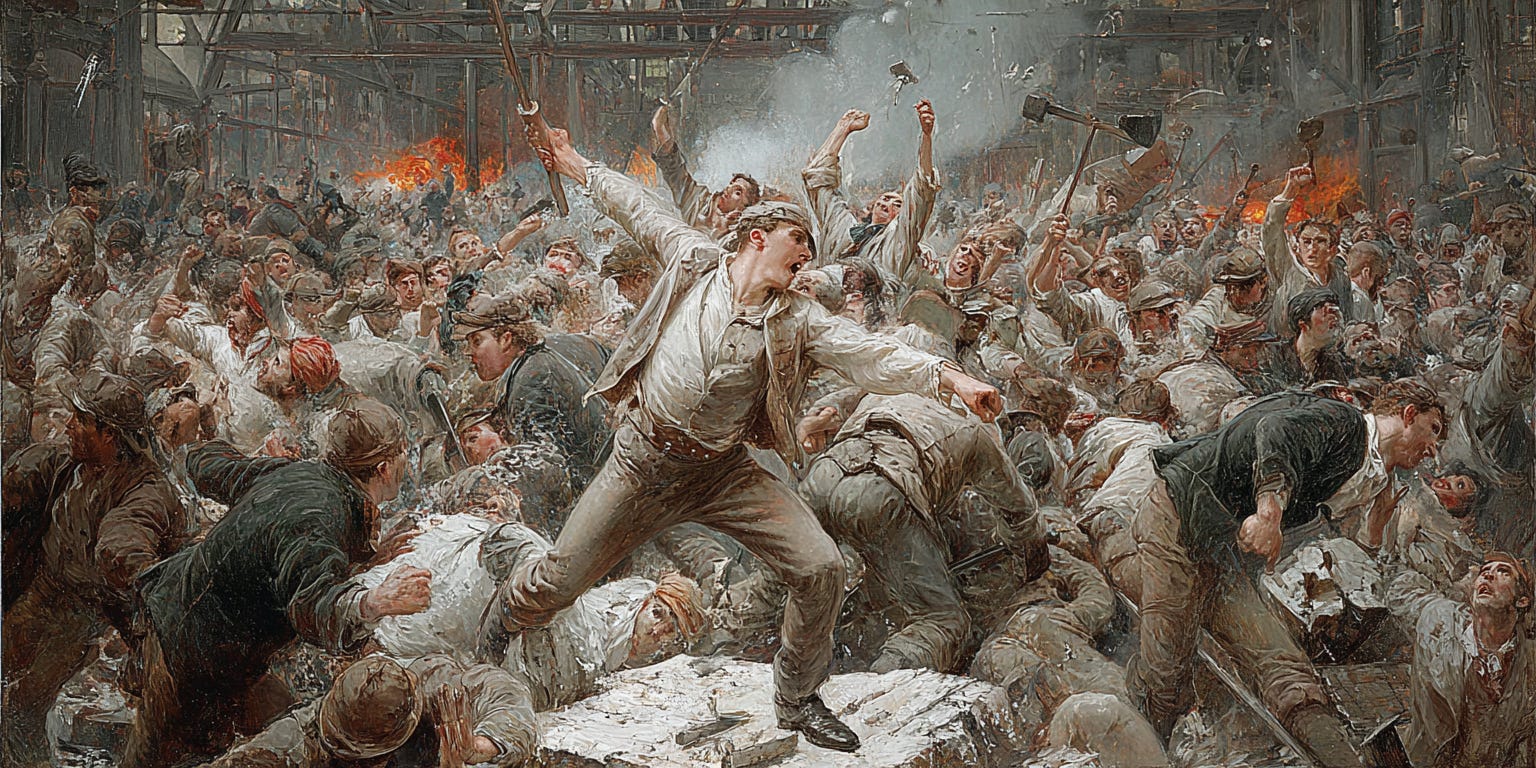
A single hollow man, by himself, is a containable problem. History has produced hollow men in roughly the quantity it has produced rocks, and the species generally exhausts itself in barroom monologues and failed real estate ventures and the slow disappointment of long-suffering relatives. What makes this particular hollow man a civilizational hazard rather than an embarrassing in-law is the standing army of volunteers, the perpetually replenishing horde of the sincerely aggrieved, who have agreed, by some mysterious telepathic consensus arrived at simultaneously across forty-eight states, to outsource their judgment to him. Stupidity is survivable. Charisma is survivable. The chemical compound formed by absolute stupidity and absolute loyalty, mixed at industrial scale and pumped into the political bloodstream over the course of a decade, is not survivable in the same way. It corrodes. It cumulates. It eventually reaches the load-bearing tissue.
Consider, with the dispassion of an engineer surveying a condemned building, the specific demolitions in progress.
The climate. We were, perhaps, going to lose this anyway, but slowly, with an outside chance of partial mitigation, with the prospect of bequeathing to our descendants something other than a planet on fire and a coastline migrating inland at the pace of an angry walk. That window, which was always going to close, is now being shoved closed with active enthusiasm by a regime that has appointed petroleum executives to oversee environmental protection, that has rolled back automobile emissions standards on the explicit theory that emissions are good, actually, that has withdrawn from international climate accords with the same blasé indifference with which a teenager quits a group project. The regulatory infrastructure that took fifty years to construct, that scientists fought for and politicians grudgingly conceded and lawyers slowly fortified, is being dismantled by a man who does not know the difference between weather and climate and would not care if he did. The followers cheer. They roll coal. They buy larger trucks. They mistake ecological suicide for cultural identity, and the saddest part is that the planet does not care about the rhetorical packaging. The atmosphere does not check your political affiliation before warming. The methane is bipartisan.
The public health system. There was, until very recently, a functioning architecture of disease surveillance and response in this country, the product of an embarrassingly long and tedious project that involved generations of epidemiologists doing genuinely boring work in genuinely unsexy buildings. That architecture is being detonated. The Centers for Disease Control is being staffed by people who have publicly denied the existence of viruses they will be expected to track. Vaccine programs, which represent the single most successful intervention in the entire history of medicine, are being undermined by a Secretary of Health and Human Services who believes wifi causes leaky brains and that a worm ate part of his actual cortex and that this experience qualifies him for the role. Diseases that we had beaten, that we had reduced to near-mythological status, that no parent in 2015 worried about for thirty consecutive seconds, are coming back. Measles is coming back. Polio is rehearsing in the wings. Whooping cough is making its return tour. None of this is hypothetical. It is happening in real time, in pediatric wards, in counties that proudly opted out of the twentieth century.
The institutional infrastructure. There is a thing called the administrative state, which is a deliberately boring term for the actual machinery by which a country of three hundred and thirty million people manages not to dissolve into a continental shouting match. It consists of agencies, regulators, civil servants, expert panels, inspector generals, the whole ungainly apparatus of grown-up governance. It is being purged. Not reformed, which is an honest project that reasonable people can argue about. Purged. The expertise is being driven out and replaced with loyalty, which is a substitution that has been tried before, in other countries, and which has never once produced a functioning state and has many times produced famines, currency collapses, infrastructure disasters, and the kind of slow-motion immiseration that takes a generation to undo. The followers, who have been told for years that the administrative state is the enemy, are watching its evisceration the way one watches fireworks. They will eventually want their drinking water tested by someone, and there will be nobody.
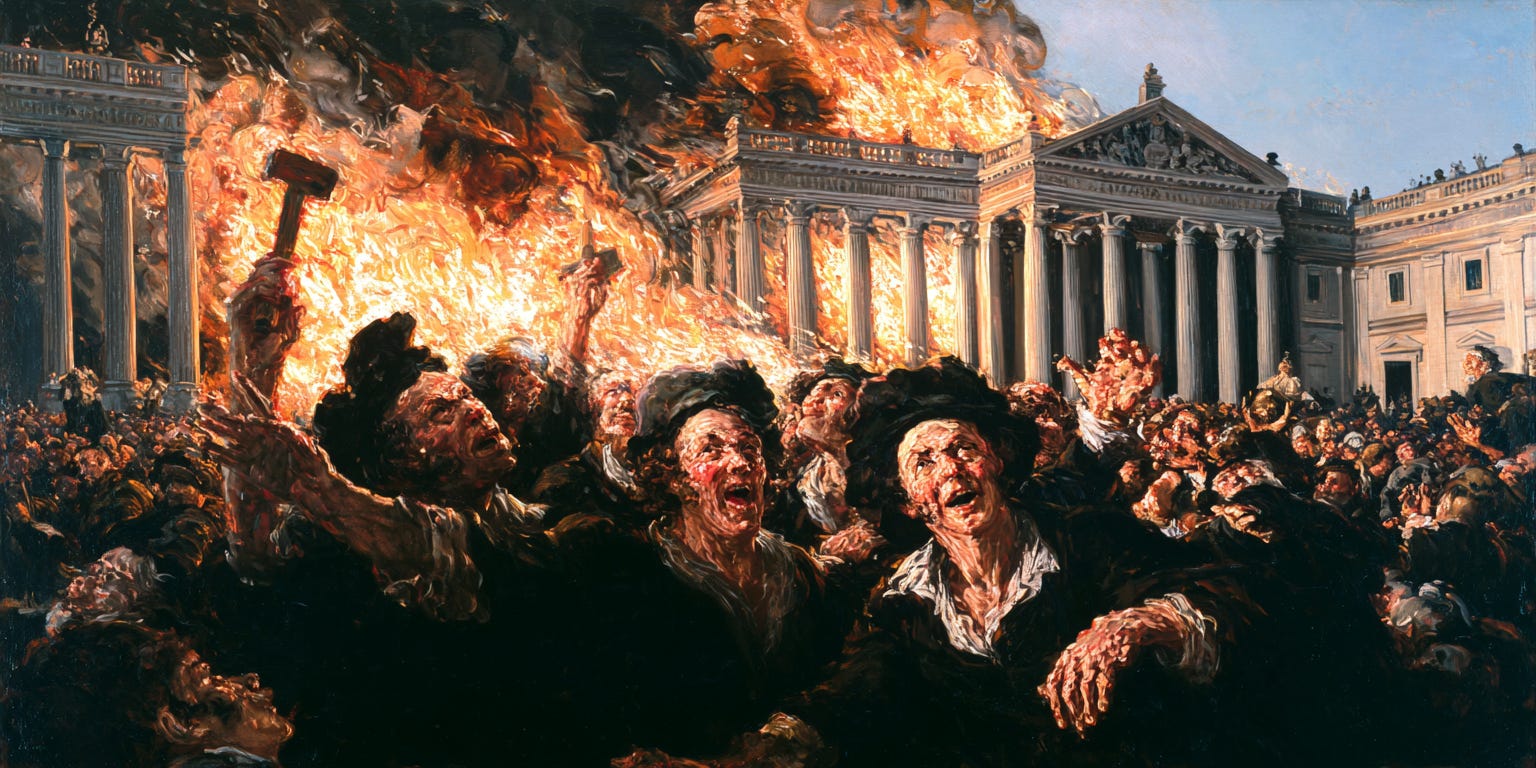
Knowledge itself. The universities, which are imperfect institutions and which have earned a portion of their criticism honestly, are being placed under siege by people whose objection is not to their imperfections but to their function. The function being: producing humans who can read difficult texts, evaluate evidence, distinguish a study from a hunch, and resist authoritarian appeals on the strength of their training. This function is incompatible with the regime. The regime requires a population that cannot tell when it is being lied to, and the regime understands, with a clarity it possesses on almost no other subject, that universities are the place where that capacity is grown. So the universities are being defunded, harassed, restructured, intimidated, accused, investigated, and slowly choked. Books are being pulled from school libraries by parents who have not read them, on the recommendation of strangers who have not read them either. History is being rewritten in real time, with the kind of confidence usually reserved for people who have not encountered any of it.
The diplomatic architecture. There is, or was, a post-war international order, constructed expensively and at enormous human cost by people who had just finished watching the previous order produce two world wars. This order had problems. It also had the merit of not having produced a third world war, which is the sort of achievement one notices mostly in its absence. That order is being torched. NATO is being treated as a protection racket. Allies are being insulted in public for sport. The traditional posture of American diplomacy, which at least involved occasionally pretending to care about norms, is being replaced with a posture of open transactionalism, in which alliances are commodities and treaties are pranks. The signal being sent to every nuclear-aspirant power on the planet is unambiguous: the postwar restraint regime has collapsed, the umbrella is folded, the moment to acquire a deterrent of one’s own has arrived. Every dictator is taking notes. Every nascent program is accelerating. The proliferation curve is bending in a direction that one would prefer it did not bend.
And then there is the matter of the codes. There is, on the planet currently, exactly one human being to whom no responsible civilization would entrust the launch authority for a weapon system capable of ending agriculture as a viable human activity, and that human being has the launch authority. The temperament question, which used to be a quaint procedural footnote in presidential evaluations, is now an existential question with a clearly wrong answer sitting in the Oval Office. The mechanism by which a brief insult on social media translates into a four-minute decision window and a launch order is shorter and more direct than the public has been allowed to fully contemplate, perhaps because contemplating it has no productive output other than terror.
The followers, in all of this, are not bystanders and not victims. They are co-engineers. They volunteered for the demolition crew. They turned up with sledgehammers. They have been told, and they believe, that the building was the problem, that the building was their enemy, that the building was constructed by people who held them in contempt, and so they will continue to swing at the load-bearing walls until something falls on them, at which point they will blame the architects. They do not see what they are dismantling because they have been raised inside an information ecosystem specifically engineered to recategorize destruction as liberation, to recategorize expertise as condescension, to recategorize the slow boring competent labor of governance as a conspiracy against them personally. They cheer the firings. They celebrate the rollbacks. They mistake the demolition of the public health system for an act of self-determination, right up to the moment their child contracts a disease that should not exist anymore, at which point they will blame the doctors, the schools, the immigrants, the chemicals in the water, and several other parties, in a sequence carefully arranged to ensure that the actual cause is never named.
What is most likely to happen, if all of this proceeds without serious interruption, is not a single dramatic apocalypse. It is the slower thing. The setback. The losing of decades of work, and the long subsequent decades of trying to recover the work, with diminished tools, in a degraded environment, with fewer experts, less trust, hotter weather, weaker alliances, sicker children, and a public conversation reshaped to make the next demolition easier. Not the end of the species, probably. Just the end of the version of the species that was tentatively beginning to outgrow its worst habits. Back to feudal arrangements, dressed in app-based clothing. Back to plagues, branded as freedom. Back to the strongman, branded as the savior. Back to the smaller, meaner, more frightened world that the twentieth century almost talked us out of and that the twenty-first appears determined to revisit, on schedule, with new merchandise.
And the unbearable detail, the thing that should keep historians awake, if there are still historians, and if they are still awake, is that the followers will go to their graves believing they were the saviors. They will believe they rescued something. They will believe the demolition was a restoration. They will believe the fire was a renewal. They built the pyre with their own hands and danced around it in their own boots and called the rising smoke the dawn, and no amount of subsequent evidence, no amount of contradictory experience, no amount of personally lived consequence will be sufficient to dislodge that conviction, because the conviction was never the product of evidence and is therefore immune to it.
That is the engine. That is how it ends, or almost ends, or sets us back a thousand years.
Not with malice. Not with cunning. With volunteers.
Top rant. A+
Stupidity and hubris will kill us all.