

Three Layers Down
The body is the avatar, the body is also all we can measure from.

Every video game is already a simulation inside a simulation before anyone reaches for cosmology. The engine runs physics. The player runs the character. The character, if written with any depth, runs an internal model of the world it inhabits. Three layers minimum, and that’s only the portion we built on purpose. Whatever else may sit above the player is a separate question, and the temptation to answer it quickly is the first thing worth resisting.
The fidelity asymmetry
The engine’s simulation is precise but shallow. A few thousand variables stand in for weather, gravity, light, the behavior of cloth, the resistance of a wooden door. None of it would survive an honest physicist’s questioning. It works because it doesn’t need to be real, only consistent enough to support the next decision. The player’s mental model is the opposite. Sloppy in its data, riddled with errors, but loaded with meaning the engine never computes. The character is afraid. The fortress is hostile. The exchange at the bridge matters in a way the engine cannot represent because the engine has no concept of mattering.
Whichever of those two layers gets called “real” depends entirely on what you’re trying to measure. If reality is what survives instrumentation, the engine wins. If reality is what survives memory, the player does. Both answers are defensible and neither is satisfying, which is roughly where you have to stand to take the rest of this seriously.
The body as avatar
Restate the old idea in the new vocabulary and notice how little it loses in translation. The body is the avatar. Consciousness is the player. Death is not annihilation but a logout, the end of a session rather than the end of the entity that ran it. The framing has a clean internal logic, and it has the further property of being already familiar to anyone raised inside a religious tradition, several of which arrive at structurally identical claims without ever touching a controller.
That convergence admits two readings. The first is that human beings keep arriving at the same architecture because the architecture tracks something real about the situation, and we are simply describing it in whatever idiom our culture has handed us. The second is that human beings keep arriving at the same architecture because the architecture is comforting, and we are constructing it from the same psychological materials in every generation. Both readings are coherent. Both are unfalsifiable from inside the system. The honest move is to hold them in suspension rather than picking one because the other makes us uncomfortable.
The bandwidth question
If the avatar model holds, the next question follows immediately. You would expect some leakage from the higher layer to the lower one. A player has access to the score, the map, the inventory across runs, information the avatar by design cannot reach. If consciousness operates at a layer above the body, you would expect that asymmetry to leave traces. Intuitions that outrun their input. Knowledge that arrives without a clear channel. Reports of awareness during periods when the avatar was, by every available measurement, not running.
The empirical record on this is messy and people lie about how messy. A substantial fraction of the phenomena dissolves cleanly under scrutiny. Confabulation explains a lot. Survivorship bias in anecdote collection explains more. The cold-reading literature is well-developed and damning for most of what passes as mediumship. But the residue is real, and it does not all collapse. The van Lommel cardiac-arrest cohort, the verified-detail subset of near-death reports, the better-controlled precognition meta-analyses, the portion of the record that survives the first three rounds of methodological filtering and continues to make people uncomfortable. The default scientific posture has been to treat that residue as noise that hasn’t yet been explained away, rather than as signal that hasn’t yet been integrated. That is a methodological commitment, not a finding, and it is worth naming as such.
None of this proves the avatar hypothesis. It establishes only that the question has not been settled in the direction the consensus pretends it has been, which is a more modest claim and also a more defensible one.
The continuity problem
Now the disanalogy, which is where the metaphor stops being comfortable. A video game player is clearly distinct from the avatar because the player predates the session and outlasts it. That external vantage is what lets us say with confidence that the two are different entities. For consciousness we have no equivalent. Nobody has filed a report from outside an avatar. Every account of subjectivity, including every account of subjectivity reportedly persisting through clinical death, comes from someone currently running an avatar of their own and reconstructing the experience afterward from inside it.
This is the part of the argument that the friendlier presentations tend to skip. A fully immersive simulation, by construction, would produce exactly the data we have. Reports from inside the system, occasional anomalous information the system shouldn’t have had access to, a persistent intuition among the participants that something larger is going on, and no way to confirm any of it from a vantage that isn’t itself inside the simulation. That description fits the avatar hypothesis. It also fits a universe in which the avatar hypothesis is wrong and we are simply pattern-recognizers who have noticed our own pattern-recognition and over-interpreted the result.
The frame cannot be confirmed from within the frame. That sentence is the whole problem in one line, and the responsible thing is to sit with it rather than around it.
Where this rhymes with the other material
A brief detour, because the topologies overlap and the overlap is worth naming. The NHI inquiry, taken seriously, occasionally surfaces reports that are consistent with entities operating at a layer of access the human avatar does not normally have. Movement that ignores inertia. Apparent indifference to the electromagnetic constraints that limit our instruments. Information transfer that does not appear to use any of the channels we know how to monitor. The simulation hypothesis and the non-human-intelligence hypothesis are not the same claim and should not be collapsed into each other, but the structural similarity is real. Both posit a layer of organization above the one we ordinarily inhabit. Both predict that contact with that layer would be rare, partial, and difficult to evidence in ways the mainstream finds satisfying. Both, if true, would carry implications most people would rather not think about for very long.
Noticing the resemblance is not the same as endorsing either claim. It is only the observation that if you take one of these inquiries seriously, the intellectual cost of taking the other one seriously is lower than the culture has tended to admit.
Closing
The temptation at this point is to offer a resolution, and the resolution would be a lie. The comforting ending says yes, the avatar hypothesis is right, your grandmother is fine, you will see her again, log out and log in and the score persists. The dismissive ending says no, the avatar hypothesis is a sentimental projection of gaming culture onto an unbearable fact, the body is the thing, the lights go out and they stay out. Both endings are emotionally satisfying for different audiences. Neither is supported by what we actually know.
What we actually know is that we are inside the avatar, that we cannot get outside the avatar to check, and that the question of whether anything sits above the avatar remains open in a way the loudest voices on both sides find professionally inconvenient to admit. The interesting work is staying inside that uncertainty long enough to think clearly inside it, instead of flinching toward whichever resolution makes the next hour easier to get through.
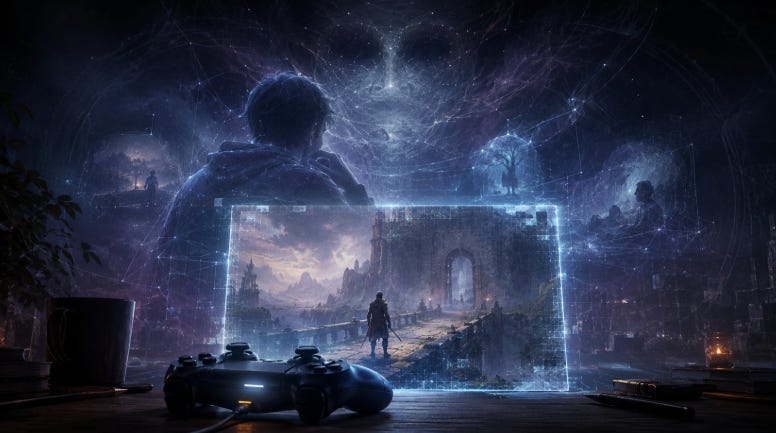
A controller on a table. The lights still blinking. The screen waiting for someone to come back.
Where is time?