
Proof of Life
A senator suffers cardiac arrest and vanishes for a month. His wife stays in China. His office recites the same sentence for weeks. Then a photo appears that even his own side thinks looks staged.

This is what the collapse of institutional trust looks like in real time.
On the morning of June 14, 2026, emergency responders were called to the Washington home of Senator Mitch McConnell for an unconscious person.
We know, from EMS dispatch audio obtained by an independent journalist, that the call was for cardiac arrest, and that a paramedic can be heard saying “CPR in progress.” We know, from video captured by a neighbor and verified by CNN, that two ambulances, a fire truck, and Capitol Police blocked the entire street. We know that a person was wheeled out on a stretcher roughly thirty minutes later, wrapped in an orange blanket, wearing no oxygen mask, feet uncovered. A neighbor described those feet, in the brief glimpse the video allowed, as “not moving.” Other neighbors said they saw his face and confirmed it was McConnell.
And we know that the ambulance carrying an 84-year-old man who had just received CPR pulled away from his home without turning on its sirens.
What happened after that is the actual story, because what happened after that was nothing. For nearly a month, the office of one of the most powerful men in the recent history of the United States Senate told the American public essentially nothing about whether he was alive, conscious, or capable of the job he still holds. And into that vacuum poured exactly the thing that secrecy always produces, which is suspicion, and the suspicion has now metastasized to the point where members of his own party are the ones calling the eventual proof-of-life photo a fake.
This is a story about a health crisis. But it is really a story about what happens to public trust when the people in power decide the public has no right to know whether their government is being run by the living.
The Month of Silence
Consider the sheer duration of the stonewall.
McConnell was hospitalized on June 14. His office issued a statement saying he had been “admitted to the hospital this morning” and was “receiving excellent care.” That was it. No diagnosis. No cause. No prognosis. And then, for weeks, McConnell’s team, led by a longtime aide on track to earn more than $226,000 this year, simply recited variations of the same non-answer whenever anyone asked. He “appreciates the outpouring of support.” He “continues to improve.” The words were chosen to fill space while conveying nothing, the bureaucratic equivalent of a dial tone.
During this month of silence, McConnell missed high-profile votes, including votes to check the president’s ability to wage war in Iran. A sitting United States senator was absent for constitutionally significant moments and his office would not tell the country whether he was conscious.
Meanwhile, his wife, former Transportation Secretary Elaine Chao, remained on a trip in China. When asked why she had not returned to her husband’s side during what was, by any reading of the EMS audio, a life-threatening emergency, her spokesperson said his health “did not warrant an immediate return to the US.” Sit with that sentence. A man receives CPR, disappears into a hospital for a month, and his wife’s team publicly assures the world that things were not serious enough for her to come home from another continent. Either that is true, in which case the earlier secrecy is baffling, or it is spin, in which case nothing this operation says can be trusted. There is no version of that statement that reassures.
The information blackout was so total that it did what information blackouts always do. It convinced people something was being hidden, because something was being hidden. The only question was what.
The Vacuum Fills
Nature abhors a vacuum, and the American information ecosystem abhors it most of all.
Into the silence rushed the rumors. On July 6, the MAGA activist Laura Loomer posted that a “high-level source” had told her McConnell was “officially brain dead” and “not coming back,” kept alive on life support machines. Whether or not you give Loomer any credence, and there is little reason to, the fact that her claim could not be immediately and definitively refuted was itself the product of McConnell’s own team’s choices. When you tell the public nothing, you forfeit the standing to complain when the public believes the worst.
Then, on July 7, an image appeared on X purporting to show McConnell in a hospital bed, covered in tubes, in visible distress. It spread across Reddit and X. And it was fake, genuinely, provably fake, generated with an AI tool. It was caught because it carried a SynthID watermark, the invisible signature that some AI image generators now embed, and fact-checkers at Snopes and elsewhere flagged it within days. That image was a hoax, and it deserves to be called one plainly.
But notice what the existence of that fake did. It poisoned the well in both directions. Now any real image could be dismissed as fake, and any fake could borrow the credibility of the genuine uncertainty. The information environment had become a hall of mirrors, and it had become one because the single entity with the power to end the speculation, McConnell’s own office, had spent a month choosing not to.
The Photograph
And then, on the evening of Sunday, July 12, they finally produced it. The proof of life.
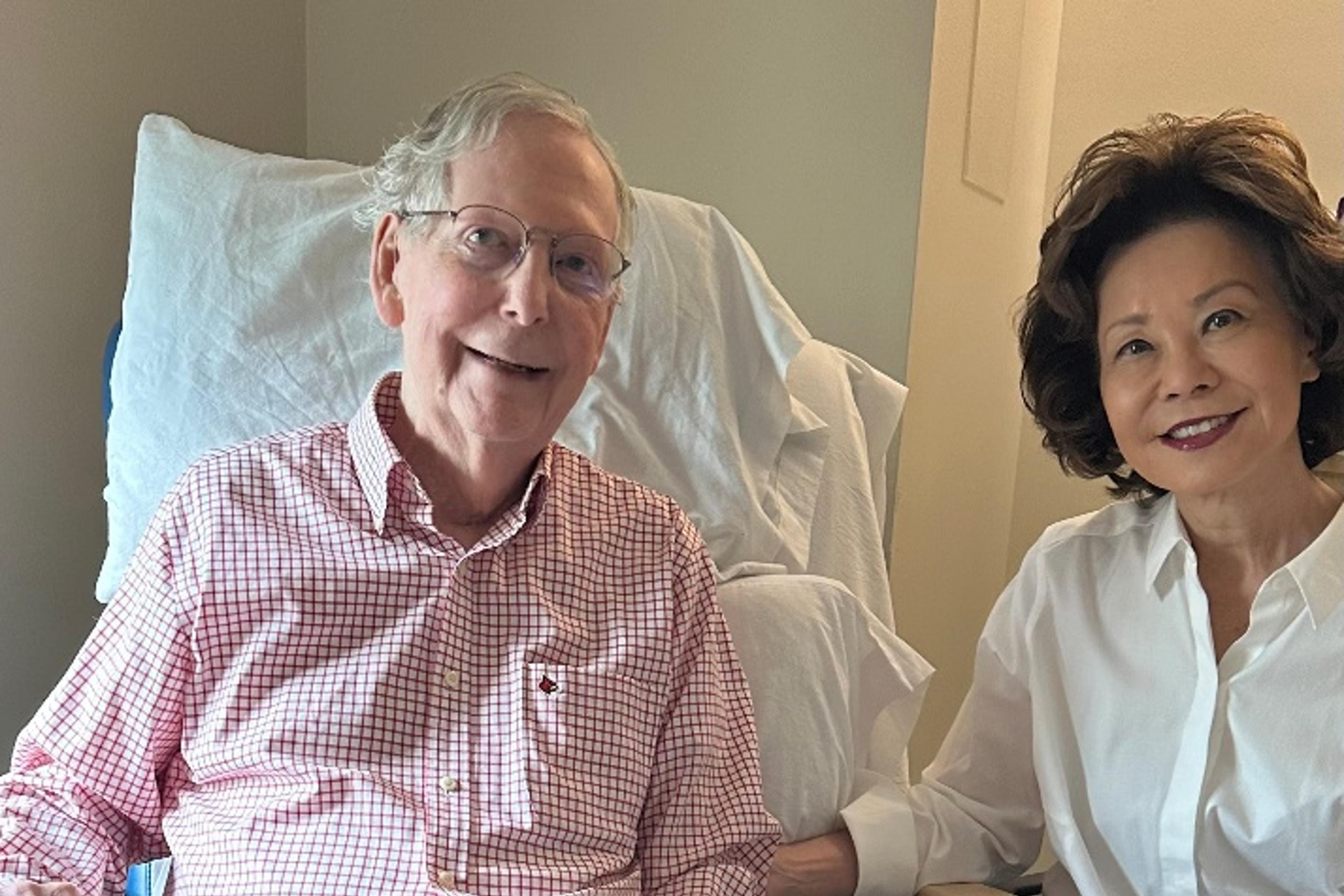
The timing alone raised eyebrows, because it landed just hours after the sudden death of McConnell’s Senate colleague Lindsey Graham, a juxtaposition that did nothing to calm an already feverish public. The image showed McConnell seated, in a red-and-white button-down shirt and jeans, beside his wife Elaine Chao, freshly returned it seems from her philanthropy in China. On his lap sat a copy of that day’s Washington Post sports section, the oldest proof-of-life cliché in the book, the dated newspaper meant to timestamp the living. Alongside it came a lengthy first-person statement explaining that he had suffered a fall, been briefly unconscious, developed a mild case of pneumonia, and suffered no heart attack, no stroke, no tumor, no hemorrhage. A note from the attending physician of Congress was attached, echoing the same.
Case closed, one would think.
It was not case closed. And here is the genuinely remarkable part: the loudest voices calling the photograph a fake were not on the left. They were on the MAGA right.
Laura Loomer looked at the image and posted that the text on the newspaper appeared “AI-generated,” demanding to know why the staff would not release a video instead of a photo that “could have been taken at any time.” She wrote, flatly, “There’s no way Mitch McConnell wrote that essay.” Jason Chaffetz, the former Republican congressman and Fox News contributor, wrote, “Let’s see you say it. A written statement is far different than saying it on camera.” The demand for a video, for a live and unfakeable confirmation, was coming from inside the house.
To be precise and fair, because precision is the whole point of this exercise: the official July 12 photograph has not been shown to be AI-generated. When users asked the AI chatbot Grok, it initially confused the image with the earlier confirmed fake and then corrected itself to say the Chao photograph was “not reported as AI-generated.” The claims of fakery about the real photo rest, so far, on people squinting at newspaper text and on a general and now bottomless well of distrust, not on forensic evidence.
But one careful independent analysis of the image concluded something almost more revealing than fakery would have been. It judged the photo to be physically real but extensively staged. The domestic-looking armchair, on close inspection, appears to be a high-end convertible rehabilitation bed set to “chair mode,” dressed with white household pillows to hide the clinical headboard and its medical gas ports. The long-sleeved shirt, the analysis noted, is exactly what you would choose to conceal IV catheters, PICC lines, or a telemetry monitor’s wires. A dark bruise on the back of his left hand is consistent with a recently removed IV line. The photograph, in other words, was not a fabrication. It was a production. A man genuinely in intensive rehabilitation, carefully costumed and posed to look like a man relaxing at home.
That distinction matters, and it cuts against McConnell’s team, not for them. A faked photo would at least have been a clean lie. What they appear to have produced instead is a real man’s real medical reality, disguised. The staging is the tell. You do not go to those lengths to make someone look healthier than they are unless the truth is that they are not.
What the Concealment Is For
So step back and ask the question that actually matters. Why. Why does an operation stonewall for a month, deploy a wife’s statement from China, recite dial-tone non-answers, and then produce a photograph so carefully staged that even allies smell the production?
The answer is the same answer that runs underneath the entire architecture of this political era, and it is about power and the desperate need to hold it.
An 84-year-old senator who has suffered cardiac arrest, whose office admits he has moved from a hospital to a rehabilitation center, is a senator whose capacity to serve is now a live and legitimate public question. But capacity is inconvenient. A Senate seat is a unit of power. Kentucky’s Republican governance, the balance of the chamber, the machinery of appointments and votes and committee control, all of it assumes a functioning occupant of that seat. To admit that the occupant may no longer be functional is to open questions that the people who benefit from the current arrangement do not want opened: questions about succession, about whether he can finish a term he has already announced he will not seek to extend, about who is actually exercising the authority that his name still carries.
We have seen this pattern before, and recently. The instinct to conceal the physical and cognitive decline of powerful officeholders is bipartisan in its history and has become a defining feature of a gerontocratic political class that treats the offices it holds as possessions rather than responsibilities. The concealment is never really for the benefit of the ailing person. It is for the benefit of the apparatus that depends on the seat staying filled and the questions staying closed.
McConnell himself, in his statement, gestured at a more sympathetic explanation, writing that people of his generation “often hesitate to share the vulnerability that comes with growing older.” And that is real, and human, and I have no wish to mock an old man for not wanting the world to see him frail. If this were merely a proud man’s privacy, it would deserve grace.
But it is not merely that, because the office is not private. The moment you hold a share of the public’s power, your capacity to wield it becomes the public’s business. The senator does not get to keep the powers of the office and the privacy of a private citizen at the same time. That is the bargain of public service, and the month of silence was a unilateral attempt to renege on it.
The Real Casualty
Here is what should trouble everyone, regardless of what they think of Mitch McConnell.
The most damning fact in this entire saga is not the cardiac arrest, or the silence, or the staged photograph. It is that when the proof of life finally arrived, a very large number of Americans across the political spectrum simply did not believe it. The reflexive, immediate, cross-partisan assumption was that the image was a manipulation, because the assumption now, about nearly everything an official institution says, is that it is a manipulation.
That is the wound. Not one senator’s health, but the fact that we have arrived at a place where the government can show us a photograph of a living man and a plurality of the country’s instinct is to assume it is a lie. Institutions spent this trust down themselves, over years, through exactly the kind of contemptuous secrecy McConnell’s office practiced for a month. They taught the public that the official story is a managed product, and the public learned the lesson, and now the well is so thoroughly poisoned that even the truth, when it finally arrives, tastes like something out of a lab.
McConnell may well be recovering exactly as his statement claims. He may return to the Senate, finish his term, and retire in January as planned. The physician’s note may be entirely accurate. I hope, for the simple human reasons, that the man is not suffering.
But whether or not the photograph is real, the thing it was meant to prove is the thing that is actually dead. Not the senator, necessarily. The proof. The very possibility that an American institution can tell the public something important and simply be believed. They spent a month killing that, and no staged armchair is going to bring it back.
The newspaper in his lap was dated July 12.
The trust it was supposed to prove has no date, because we can no longer find the body.
Staged?
The photo was taken YEARS ago
And/Or it is AI assisted
My understanding is that a Google reverse seach shows that the photo of McConnell and his wife which we're discussing here is in fact a photo taken of McConnell in 2023 when he was indeed in rehab after a fall. It's a real photo, taken in 2023 with what appears to be a newspaper grafted into the image to make it appear it was dated yesterday.