

Fighting the Spiral
The political environment is designed to exhaust you, isolate you, and grind you down. What that does to a mind is not weakness. It is the point. Here is how to fight back.

I want to start with anger, because the anger is legitimate and I am not going to ask you to set it down.
We are living through something that was engineered to hurt. The cruelty is not a side effect of this administration’s politics. It is the product. The performances of dominance, the deliberate humiliations, the daily manufacture of new outrages timed to arrive before you have metabolized the last one, the sheer relentlessness of it: none of this is accidental. It is a machine, and the machine runs on your attention and your distress, and it is very good at extracting both.
You are not imagining the toll. You are not weak for feeling it. The exhaustion you are carrying is the exhaustion of a person being subjected, day after day, to a firehose of engineered cruelty by people who want you demoralized, because a demoralized opposition is a defeated one.
And here is the part that the machine does not want you to notice: the damage does not stop at your politics. It seeps into your life. It gets into your marriage. It sits down at your dinner table. It follows you into the group chat that used to be a refuge and is now a minefield. It costs people friendships, and in a growing number of cases it costs them marriages, and underneath all of that it is doing something quieter and more dangerous, which is grinding down the mental health of millions of people who never consented to be casualties in someone else’s culture war.
This piece is about that. It is about the spiral. And it is about how you fight it, because you can, and because you have to, and because letting it take you is the one outcome the people who built the machine are actively rooting for.
What the Spiral Actually Is
Let me describe it clearly, because naming a thing is the first step in fighting it.
The spiral starts with a normal, healthy response to a genuinely bad situation. You are angry, because anger at injustice is correct. You are anxious, because the future is genuinely uncertain and the threats are genuinely real. You are sad, because things you valued are being dismantled and that is genuinely a loss. None of these feelings is a malfunction. They are your conscience and your intelligence working exactly as they should.
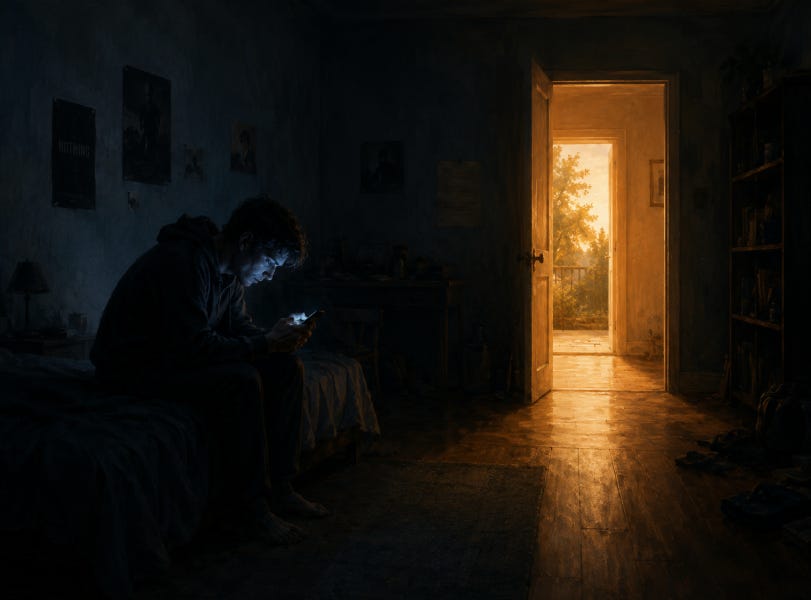
But then the situation does not resolve. It cannot resolve, not on the timeline your nervous system is built for. Human beings are designed to respond to acute threats, to spike adrenaline, act, and then return to baseline. We are not designed to sit in a threat state for months and years without relief. And so the healthy response, held too long with no exit, begins to sour into something else.
The anger becomes a low constant hum that never switches off. The anxiety becomes a background dread that colors everything, including the things that used to bring you joy. The sadness deepens and starts to generalize, until it is not just about politics anymore but about everything, about you, about whether any of it matters, about whether you matter. The engagement that once felt like resistance starts to feel like compulsion. You refresh the feed knowing it will hurt you and you do it anyway. You lie awake composing arguments with people who will never be persuaded. You wake up already tired.
This is the spiral. It is the conversion of legitimate moral response into self-corroding despair. And its cruelest feature is that it disguises itself as virtue, because it tells you that to look away even for an hour, to protect your own mind even briefly, is a betrayal of the people who are suffering more than you are. The spiral weaponizes your own conscience against your own survival.
The Research Is Not Ambiguous
This is not a soft concern or a matter of opinion. The measurable mental health effects of the current political environment are documented and substantial.
The American Psychological Association has tracked “political stress” as a distinct and growing category for years now, through its Stress in America surveys, and the numbers have climbed steadily. Large majorities of Americans consistently report the political climate as a significant source of stress in their lives. Researchers studying the phenomenon have documented physical symptoms directly attributed to political stress: lost sleep, intrusive thoughts, fatigue, difficulty concentrating, and in a meaningful subset of people, symptoms consistent with clinical anxiety and depression.
There is a body of research on what some clinicians have termed “political anxiety” and its physiological signature. Chronic activation of the stress response, the sustained elevation of cortisol that comes from a threat that never resolves, is corrosive to the human body and mind in ways that are well understood. It degrades sleep. It impairs immune function. It worsens cardiovascular health. It is directly linked to the onset and worsening of depressive and anxiety disorders. This is the same mechanism that makes chronic stress of any kind dangerous, and a political environment engineered for maximum sustained outrage is, functionally, a chronic stress delivery system.
The relational damage is documented too. Surveys have found significant and rising numbers of Americans reporting that political differences have damaged their family relationships and friendships. People report estrangement from parents, from siblings, from adult children. Therapists have described a marked increase in couples presenting with political conflict as a primary or contributing factor in their distress. This is not a handful of anecdotes. It is a broad social pattern, and it is getting worse, because the environment is designed to make the divides feel total, to convert every disagreement into a referendum on whether the other person is fundamentally good.
You are not fragile for being affected by this. You are a normal human being having a normal human response to abnormal and sustained conditions.
How the Spiral Ends Up Somewhere Dangerous
I want to be honest about where this can go, because the honesty is part of the help.
Untreated, unmanaged, the spiral does not stay put. Chronic despair looks for relief, and the relief it reaches for is not always healthy. For some people it becomes alcohol, the drink that takes the edge off the dread that becomes two drinks that becomes a bottle that becomes a problem. For some it becomes other substances. For some it becomes a compulsive relationship with the very media that is hurting them, a doomscrolling that functions like an addiction, complete with the craving and the shame and the inability to stop.
And for some, the despair turns outward. The person who is being ground down becomes short, then harsh, then cruel to the people closest to them, because the pain has to go somewhere and the people we love are the ones in range. Homes that should be refuges become tense. The children in those homes absorb the tension. The partner absorbs the tension. The spiral, left unmanaged, does not just hurt you. It radiates.
I am not saying this to frighten you. I am saying it because if you recognize yourself in any of it, I want you to understand that recognition is not a verdict. It is a diagnosis, and things that can be diagnosed can be treated. The person who notices they are drinking more, snapping more, sinking lower, and names it honestly, is not the person the spiral wins against. They are the person who just took the first step out of it.
What Fighting Back Actually Looks Like
So here is the part that matters. Here is how you fight the spiral, in concrete terms, drawn from what actually works.
Name it and externalize it. The single most important move is the one you make by simply understanding what is happening to you. The despair is not a true report about the state of your life or your worth. It is a predictable physiological and psychological response to sustained engineered stress. When you can say to yourself, this is the spiral, this is the machine doing to me exactly what it does to everyone, you have already begun to loosen its grip, because you have stopped experiencing it as a private failing and started seeing it as an external force to be resisted.
Reclaim control of the intake. You do not have a moral obligation to consume every atrocity in real time. This is the hardest thing for engaged, conscientious people to accept, and it is the most important. Staying informed does not require staying inundated. You can check the news once or twice a day at times you choose rather than letting it colonize every waking moment. You can mute the accounts that exist purely to enrage. You can leave the group chat that has become a wound. Turning down the firehose is not disengagement. It is the precondition for sustainable engagement. A depleted person helps no one. A person who has protected enough of their own mind to stay in the fight for the long haul is exactly what the moment requires.
Convert helplessness into action, at a human scale. Much of the despair comes from the gap between the scale of the problem and the scale of your power over it. You cannot personally fix the country. But you can do the local, concrete, human-sized thing that is actually within reach: the volunteer shift, the donation, the phone call to the representative, the mutual aid, the showing up for one specific person who needs it. Action at human scale is one of the most reliable antidotes to political despair, because despair feeds on passivity and starves on agency. The point is not that your one action saves the republic. The point is that doing it reminds your nervous system that you are an agent and not only a spectator.
Protect the analog world. The spiral lives online. It shrinks in the presence of real, embodied, in-person life. Time outside. Time with your hands doing something. Time with people you love, deliberately walled off from the subject that is hurting you. The relationships worth protecting are protected in part by agreeing, together, that they are bigger than the news cycle, that this table, this walk, this evening is off-limits to the machine. Guard those spaces like they matter, because they do.
Tend the body, because the body is where the stress lives. Sleep is not optional and the spiral will attack it first. Movement discharges the physiological stress that political anxiety loads into the body. These are not trivial self-care clichés. They are the direct, mechanical counters to the exact physical processes that chronic political stress sets in motion.
On Getting Help, Plainly
And here is the thing I most want you to hear.
If you have read this far and recognized yourself, if you know the drinking has crept up or the darkness has deepened or the person you are becoming at home is not the person you want to be, please understand two things at once.
You are not alone. What you are experiencing is happening to enormous numbers of people right now, quietly, in homes all over the country and the world, and the isolation you feel is itself a symptom of the thing, not a truth about your situation.
And you are not irreparably broken. Whatever the spiral has convinced you of, it is lying about this. Minds recover. Marriages recover. People climb out of far deeper holes than the one you may be in, and they do it all the time, and they do it most reliably when they stop trying to do it entirely alone.
There is no shame in professional help. A good therapist is not a luxury or an admission of failure. They are a trained ally in exactly this kind of fight, someone whose entire job is to help you get your feet back under you and find the path back to yourself. If the spiral has you, reaching out to a mental health professional is not weakness. It is the single most competent and courageous thing you can do, for yourself and for everyone who loves you and needs you whole.
The people who built this machine want you isolated, exhausted, numbed, and convinced that your suffering is a private defect rather than a shared and treatable condition. Every part of that is a lie. The most defiant thing you can do, in an environment engineered to grind you down, is to refuse to be ground down. To protect your mind. To hold onto the people you love. To get help when you need it. To find your way back to happiness and to the sense of control that this environment is designed to strip from you.
That is not giving up the fight.
That is how you stay in it.
This is on point. They want us exhausted. They want the chaos to overwhelm us to the point nothing surprises us so the next unimaginable, corrupt, thieving, lying event is just another event in the news cycle. Yes, we need to take care of ourselves. We need to unplug for a little while. But we must keep up the fight. We must carry on and stand up, every day. If we do not, all is lost.
What the moment's engineers should understand, is that there are those of us who have experienced more than they could comprehend, survived it, and grown stronger from it. We exist, we are finding each other, and sooner or later, we will come for them. There are more of us, no one is more acutely aware of this than they are, we are stronger together, so this is where folks need to start, in understanding they're not alone. This is an important message.