
Donald, The Eulogist
When other people die, Donald Trump becomes the subject. A pattern, documented across a decade of deaths, and what it reveals about the man delivering the tributes.

At 2:21 in the morning, hours after Lindsey Graham died, the President of the United States posted a tribute that found its way, in six short sentences, back to himself. Graham was one of the greatest people the President had ever known. Details and arrangements would follow. And then, at the bottom, in capital letters, a signature: President DONALD J. TRUMP, in case anyone reading a post on Trump’s own platform had lost track of who was talking.
It would be easy to treat this as a one-off, the product of a bad night and a worse habit. It is not. It is a pattern, and the pattern is old, and it is remarkably consistent, and once you see it you cannot stop seeing it. When other people die, Donald Trump makes himself the subject. Every time. Without apparent exception. The death is an occasion; he is the topic.
This essay is a catalog of that pattern, because the catalog is the argument.
Colin Powell
When Colin Powell died in October 2021, the first Black Secretary of State, a four-star general, a chairman of the Joint Chiefs, Trump did not release a statement of condolence. He waited. And then he released a statement that was not about Powell at all.
“Wonderful to see Colin Powell, who made big mistakes on Iraq and famously, so-called weapons of mass destruction, be treated in death so beautifully by the Fake News Media,” Trump wrote. And then the line that belongs in a textbook: “Hope that happens to me someday.”
Read that again. A man had been dead for one day, and Trump’s response was to express envy at the quality of his press coverage, and to openly wish that he, Trump, would one day receive the same flattering treatment upon his own death. He went on to call Powell “a classic RINO” who was “always being the first to attack other Republicans,” which is to say he assessed a dead man’s worth entirely by the dead man’s loyalty to Trump. The tribute closed with “he made plenty of mistakes, but anyway, may he rest in peace,” the verbal equivalent of a shrug over an open grave.
Powell’s death was a mirror, and Trump looked into it and saw only himself, and what he felt was jealousy.
Ruth Bader Ginsburg
When Ruth Bader Ginsburg died in September 2020, Trump was mid-rally in Minnesota and did not know for over an hour. When told, he managed a brief and uncharacteristically gracious statement, which suggests that his handlers wrote it and got to him before the reflex did.
The reflex arrived later, and it has kept arriving. As recently as April 2026, discussing the possibility of a Supreme Court vacancy, Trump reached back to Ginsburg’s death and framed it, unprompted, as a story about his own good fortune. Ginsburg “could not do it,” he said, meaning she declined to retire under Obama, “and she really hurt herself within the Democrat Party. People are very angry at her, because I got to appoint people instead of Biden.”
Sit with the framing. A woman’s death, and the lesson Trump draws from it, years later, is that it worked out well for him. Her timing was a gift to his presidency. The tragedy of her passing is reframed as a strategic error on her part that redounded to his benefit. He is not even the villain of this telling. He is the beneficiary, and he says so with satisfaction, as though her death were a transaction that closed in his favor.
John McCain
John McCain is the purest case, because Trump could not stop even after McCain was dead.
While McCain lived, Trump said he was “not a war hero,” that he was “a war hero because he was captured,” and that Trump preferred “people that weren’t captured.” The disqualifying sin, in Trump’s accounting, was that McCain had been a loser: “He lost, so I never liked him as much after that, ‘cause I don’t like losers.”
McCain died in August 2018. Trump’s animus did not. He complained about having to lower flags. He reportedly groused about the funeral, to which he was pointedly not invited. Months and even years after McCain’s death, Trump was still relitigating his grievances against the man at rallies, still bringing up a dead senator to a live crowd, still unable to let a corpse have the final word. In 2019 he mused aloud that he had never received a thank-you for approving McCain’s funeral arrangements, which is a sentence that requires the reader to understand that Trump believed a dead man owed him gratitude.
The pattern here is not neglect. It is the opposite. It is an inability to stop making a dead man’s memory into a stage for Trump’s own wounded pride.
Lindsey Graham
Which brings us back to Saturday night, and to the tribute that occasioned this essay.
Graham got warmer words than Powell or McCain, because Graham, unlike them, died loyal. He had made his peace with Trump years ago, had become one of his most reliable surrogates, and so he was rewarded in death with “one of the greatest people and Senators I have ever known.” The warmth was real, in the sense that Trump’s warmth is always real when it is directed at someone who submitted.
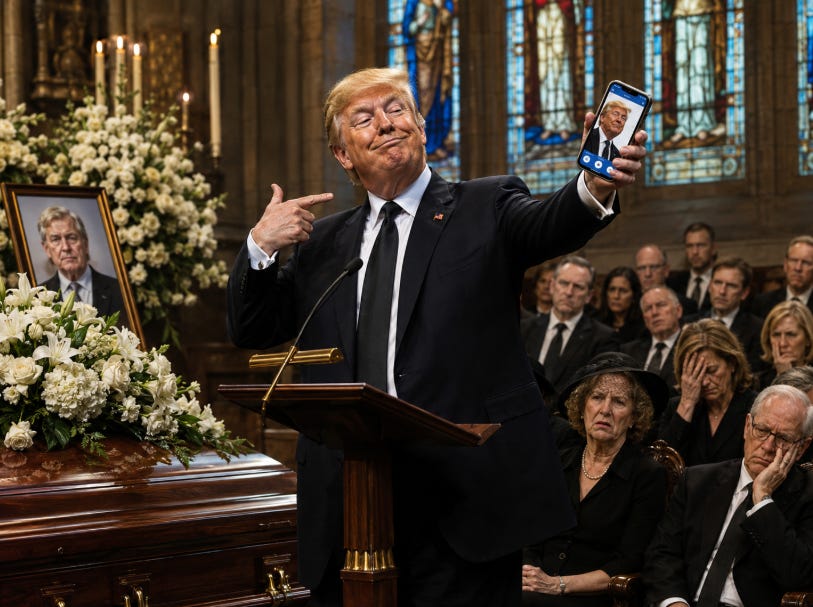
But even in the warmth, the pattern held. The tribute pivoted into event logistics, “DETAILS AND ARRANGEMENTS TO FOLLOW,” as though Trump were promoting an appearance. And it ended with the signature, the compulsive need to append his own name and title to a message about another man’s death, on a platform where his name already sat at the top in bold. The dead man’s tribute became, at its conclusion, an advertisement for the living man delivering it.
Loyalty bought Graham kinder adjectives. It did not buy him the one thing none of the dead ever get from Trump, which is to be the actual subject of their own eulogy.
Why He Does It
So why. Why can this man not let a death be about the person who died.
The clinical vocabulary is available and a chorus of mental health professionals has spent a decade applying it, but you do not need a diagnosis to see the mechanism, because the mechanism is visible in every example above. To Trump, other people are not fully real as separate centers of experience. They are inputs to his own story. They are loyal or disloyal, useful or useless, winners or losers, and those categories are defined entirely by their relationship to him. A person who dies does not exit this framework by dying. Powell is still a RINO. McCain is still a loser. Ginsburg is still a woman whose choices affected Trump’s judicial appointments. Graham is still, even in the warmth, a supporting character in the Trump production.
This is what it means to lack the capacity that the rest of us use, automatically, to mark a death: the ability to hold, however briefly, the reality of another person as a full and separate human being whose life had meaning independent of our own. Most people can do this even for their enemies. It is why funerals were, for most of American history, moments of truce. The recognition of a shared mortality was stronger than the partisan divide, because standing at the edge of a grave reminds a person that they too will lie in one, and that reminder produces humility.
Trump does not appear to experience that reminder. When he stands at the edge of someone else’s grave, he does not think about his own mortality with humility. He thinks, as he said of Powell, “hope that happens to me someday,” meaning the good press. The grave is not a memento mori. It is a marketing case study. He looks at a dead man and calculates his own future coverage.
There is a kind of loneliness buried in this that is almost tragic, if you let yourself sit with it. A man who cannot recognize other people as fully real is a man who has never, in the deepest sense, had company. Every room he has ever been in contained only him and a collection of instruments. But the tragedy is his, and the cost is ours, because a person who cannot mark another’s death is a person who cannot value another’s life, and we have handed that person the power to spend lives by the thousand.
Watch what he does the next time someone dies. You already know the shape of it. There will be an assessment of the dead person’s loyalty. There will be a grievance, or a boast, or an expression of envy at the coverage. And there will be, somewhere in it, unmistakably, the return of the subject to himself, because for Donald Trump there has never been any other subject.
He is the only person at every funeral, even the ones he isn’t invited to.
The narcissist-in-chief has to be the bride at every wedding and the corpse at every funeral.
Remember bow gleeful this orange slop was when Mueller died. He also, when fallen military men came back in coffins fighting his bogus unprovoked and now a "never ending "war he created in Iran and actually wore his own business produced campaign hat when he met them in coffins coming off the plane. It was hideous and a disgrace . Faux propaganda entertainers used an older clip of him without his campaign hat in another war as military men in coffins came home, to hide his pitiful display recently. I don't see him being there to m yet anymore military members who have died since. I guess he can't be bothered or they are not being returned back to our country to avoid showing all the casualties to the American people. He had referred to dead military and those captured as "sucker and liser" from a cowardly cadet bone spurs who never fought for our country at all... diagnosed with those spurs by a doctor who happened to be renting his office from his daddy who also detested anyone at service to another or country cuz he considered it demeaning and should only at service to yourself. And his son bar -rot, has broken the law by not registering with the military draft like every man must do once they turn 18 years old. But is a grifter as his father and his mother, melanoma. Betcha if he was subjected to the draft, DR .Oddballs,would suddenly find him having "bone spurs " too.