

Disclosure Is Imminent
The convergence is no longer subtle. Within twelve days the topic arrives on the Capitol steps, on the President's desk, and in Spielberg's theater.

Something is happening, and it is happening at a pace that has, over the past four months, ceased to be deniable to anyone watching the calendar instead of the cable news cycle. The topic of unidentified anomalous phenomena, which has spent the previous seventy-eight years filed under the bureaucratic equivalent of not here, not now, and not for you, is undergoing in the spring of 2026 the kind of compressed, simultaneous, multi-channel pressure event that historians, looking back, will eventually describe as a phase transition. Seven distinct vectors of disclosure are converging inside a twelve-day window. The convergence is not a coincidence. It is not the manufactured product of a single news cycle. It is the outcome of a thirty-year buildup of testimony, evidence, and pressure, and it is arriving, with or without permission, on schedule.
A short inventory.
On Tuesday, June 9, on the steps of the United States Capitol, a bipartisan group of high-level officials and credentialed whistleblowers will convene to issue a formal public call to action on the release of UAP records. David Grusch, the former Air Force and National Geospatial-Intelligence Agency intelligence officer who, in July 2023, testified under oath before the House Oversight Committee that the United States is in possession of non-human craft and biological remains, will be present. So will the lawmakers who have spent the past two years assembling the legislative architecture for forced declassification, including Tim Burchett and Jared Moskowitz, co-chairs of the bipartisan House UAP Caucus, and Anna Paulina Luna, who chairs the Task Force on the Declassification of Federal Secrets. Their immediate target is the passage of the UAP Disclosure Act, modeled on the 1992 JFK Records Act, which would compel federal agencies to release UAP records on a defined timeline subject to enumerated national-security exceptions. Grusch’s pre-event statement, in his own words: “President Trump now has a historic opportunity. This press conference is about moving from testimony to action. Let the American people judge the facts for themselves.”
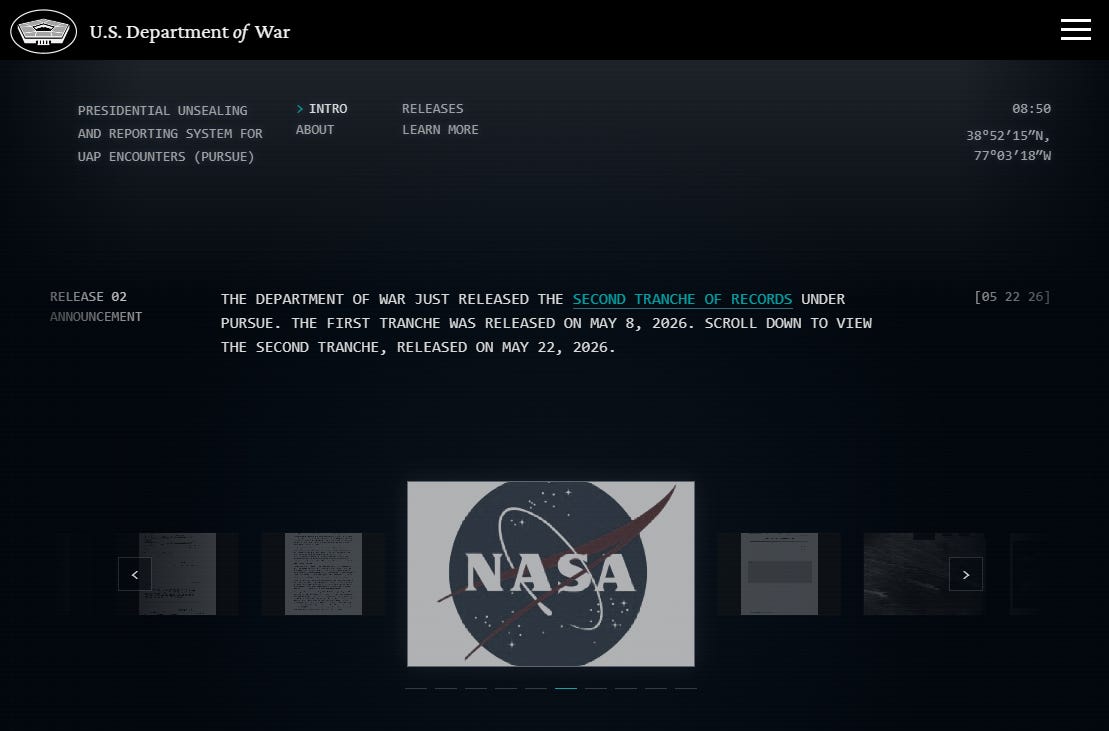
On the executive side, the President signed an executive order in February 2026 establishing the Presidential Unsealing and Reporting System for UAP Encounters, abbreviated PURSUE, which independent disclosure trackers have characterized as the most systematic government UAP release effort since the JFK Records Act itself. Representative Eric Burlison, a Missouri Republican on the relevant committees, has described Trump as the first president to take concrete steps toward UAP transparency. One does not have to feel anything in particular about the President to register the fact that he has, on this single subject, signed his name to an unsealing apparatus that prior administrations declined for four decades to attempt. The mechanism exists. The signatures are on file. The career intelligence officials have begun the standard institutional slow-walk, which Burlison himself has flagged in public, and the next phase of the fight will be conducted across the gap between the order and its actual implementation.
On January 23 of this year, the House Oversight Subcommittee held the most substantial public UAP hearing in three decades. Air Force veteran Dylan Borland testified, under oath, that in the summer of 2021 he witnessed an enormous triangle-shaped craft hovering above Langley Air Force Base in Virginia, with a substance moving across its surface that he described as resembling plasma or lava, that he watched it for approximately fifteen minutes, that its center accelerated from low altitude to commercial-aviation altitude in a fraction of a second, and that the surrounding air smelled of static electricity and post-thunderstorm ozone. He testified that he was subsequently taken aside by senior enlisted personnel and instructed to keep the observation to himself. Jeffrey Nuccetelli, another Air Force veteran, described five separate UAP incidents at Vandenberg Air Force Base, where he was stationed at the time. The committee was shown video footage of a missile striking and bouncing off an unidentified spherical aerial object. None of the testifying witnesses is anonymous. All of them are on the public record. They are not pseudonymous social-media accounts. They are decorated members of the United States military.
On May 27, two days ago, the defense contractor MITRE Corporation agreed to comply with a congressional request for UAP-related records and assets dating back to 1930. MITRE has, since the postwar period, sat at the technical and analytical center of the United States military-industrial apparatus, and a voluntary compliance posture from MITRE on UAP historical records in response to congressional pressure would have been unthinkable in any previous decade of this story. The records have not yet been delivered. The compliance itself is the news.
On the international physical-evidence front, the so-called Buga sphere, a smooth metallic spherical object roughly fifty centimeters in diameter, recovered in early March 2025 from a field in Alto Bonito on the outskirts of Buga, Colombia, has been moved, over the past fourteen months, from Colombian custody into the custody of Mexican investigators, examined by X-ray tomography under the supervision of Dr. Velasquez and his team, found to be composed of three concentric metallic layers wrapped around a central nucleus housing what initial imaging describes as a symmetric arrangement of nine to eighteen smaller internal microspheres, and reported to bear surface glyphs of unknown provenance. It appears by name in a piece of federal legislation introduced this year by Eric Burlison. The sphere has not, to date, been peer-reviewed in the conventional academic sense, and reasonable skeptics, including some of the analysts who have examined it, have urged caution. It is also, in the simple sense of being a tangible object in declared custody under documented analysis, in a different category than any UAP claim of the previous half-century.
The Bob Lazar documentary, S4: The Bob Lazar Story, directed by Luigi Vendittelli and currently streaming on Amazon Prime, returns to Lazar’s 1989 revelations with thirty-five years of subsequent context, contemporary high-fidelity recreations of the rooms and craft he described, and interviews with George Knapp, the Las Vegas investigative reporter who originally broke the story and whose journalistic record on this beat is now its own multi-decade institution. The film does not ask the viewer to believe anything it cannot demonstrate. It is, however, the first time Lazar’s account has been visually reconstructed at a production level that places the audience inside the spaces he has been describing for thirty-five years. The story, once dismissed as the strangest fringe in American UFO discourse, is, in 2026, screened in living rooms with the same production values as any prestige documentary on any contested historical episode.
And on June 12, three days after the Capitol Hill press conference, twelve days from this writing, Steven Spielberg, the director of Close Encounters of the Third Kind and E.T., the most successful cultural translator of extraterrestrial themes in the history of American cinema, will release his first feature film since 2022, titled, without any apparent embarrassment, Disclosure Day. The film’s logline is a single sentence presented as a question: If you found out we weren’t alone, if someone showed you, proved it to you, would that frighten you? In a recent interview, Spielberg said that he is “much more inclined now” than he was when he made Close Encounters in 1977 to believe that we are not the only intelligent civilization in the universe. In the same conversation, he asked the audience aloud whether it wouldn’t be wonderful for people to know all of this is true. The cultural pre-positioning, as a matter of pure release-calendar engineering, is not an accident. Studios do not name films Disclosure Day in the same month a sitting president signs a UAP unsealing executive order, and a bipartisan caucus holds a press conference on the Capitol steps demanding the release of files. The cultural mechanism is loading the public for an event whose timing is being chosen by other people in other rooms.
None of these vectors, taken in isolation, would justify the word imminent. Lazar alone would not. Disclosure Day alone would not. The Capitol Hill press conference, the executive order, the MITRE compliance, the Buga sphere, the January testimony, and the Spielberg release. Taken together, inside the same twelve-day window, they constitute a pattern recognition problem that no honest observer of this topic can responsibly decline to perform.
The credible journalists who have built the modern UAP beat have been describing this exact convergence for several years and are now, finally, watching it land on the calendar they predicted. George Knapp has been on this story since the original Lazar interviews in 1989. Jeremy Corbell has chained witness testimony to documented military footage across a decade of patient case-building. Ross Coulthart, in long-form investigative work first in Australia and now in the United States, has tracked specific named whistleblowers across multiple chains of disclosure with the same standards of source verification that any serious newsroom applies to any other national-security beat. The pattern is not invented. The witnesses are not anonymous. The legislation is not theoretical. The executive order has been signed. The contractor has complied. The hearings have happened. The film opens in twelve days.
What remains is the evidence itself. The high-resolution video, in its native 4K, without the redactions and the resolution-degradation that have been the standing trick of the disclosure apparatus for forty years. The non-redacted incident reports. The chain-of-custody documentation for the material assets that multiple credentialed whistleblowers, under oath, in front of Congress, have testified are in the United States government’s possession. The names of the programs. The recovered craft, if recovered craft, is what is being held. The biological remains, if biological remains are what are being held. The photographs and footage that are now, in some cases, more than fifty years old, and whose only justification for continued classification at this point is the protection of program names and methods, neither of which is, under any standard public-records framework, sufficient grounds to keep the underlying material behind a wall in perpetuity.
Disclosure is not a position. It is the default, in any functioning democracy, once a topic has been pulled out of the bureaucratic shadow long enough for the public to ask the question in good faith. The American people have asked. The Congress has asked, in bipartisan formation, on a topic that has produced more cross-aisle agreement in two years than the federal budget has produced in twenty. The President has, on this single question, signed his name to an apparatus specifically designed to answer. The journalists have done the documentation. The witnesses have testified, under oath, in their own names, with their security clearances and careers on the line.
The pressure is on. The momentum is, for the first time in seventy years, genuinely there. The fringe has become the floor.
Release the four-K videos. Release the photographs. Release the chain-of-custody records. Release the names of the programs. Release the real evidence.
The American people deserve, at the absolute minimum, the chance to look at it themselves.
Please check out my new book for about the same price as a cup of Starbucks coffee and learn about one of life’s most significant journeys: https://www.amazon.com/dp/B0H37KYQT3
Given the time and effort require to shoot, edit, and release a major motion picture -- and the impulsively chaotic moment-by-moment approach of the tRump regime -- I'm hard-pressed to imagine them doing any long-term planning to release this data now. Their focus has been on neutering any true democracy in America while enabling tRump and his fellow billionaire grifters to loot even more of the public treasury as they work to institute a Christian Nationalist autocracy on the line of that portrayed in "The Handmaid's Tale."
That said, it's reasonable to assume they read about the pending release of Speilberg's movie, then decided to seize the moment to dump a massive load of questionable UFO files as a means of distracting the voting public from the ongoing damage the regime is doing.
Is there intelligent life elsewhere? I'd bet big on "yes" -- there are too many stars in too many galaxies to assume that humans represent the only spark of life in the universe.
What I'm increasingly doubtful of is the survival of intelligent life right here on earth.
I immediately thought of Iran's Lego video about UFO's as a mass distraction 👽🍸
https://substack.com/@politicalhumor/note/p-197112008?r=3uhfay